
When Cars Became the Center of Modesto’s Youth Culture
During the 1950s and 1960s, automobiles became much more than a convenient way to travel around Modesto, California. They became symbols of independence, social identity, personal style, and youthful freedom. For teenagers growing up in Stanislaus County during these decades, owning a car, riding with friends, visiting drive-in restaurants, and cruising through downtown were important parts of everyday life.
Modesto developed a particularly recognizable car culture during this period. Young drivers gathered along downtown streets, especially around 10th Street, where cruising became a familiar weekend activity. Drive-in restaurants provided places to meet friends, admire customized vehicles, listen to popular music, and spend time away from home. Classic American automobiles, from Chevrolet Bel Airs to Ford Thunderbirds, helped define the appearance and personality of this emerging youth culture.
The city’s cruising tradition eventually became internationally recognized through filmmaker George Lucas and his 1973 movie American Graffiti. Although the movie was released after the period it portrayed, its depiction of teenage life in 1962 drew heavily from Lucas’s experiences growing up in Modesto. The film helped preserve the memory of a particular moment in American history when cars, music, friendships, and the open road were closely connected.
However, Modesto’s car culture was more than a movie-inspired story. It developed through local businesses, changing transportation patterns, postwar prosperity, high school social life, and the growing popularity of automobiles throughout California. The history of early Modesto cruising provides an interesting way to understand how a Central Valley community experienced the broader cultural changes of the 1950s and 1960s.
1. Modesto After World War II: A City Changing With the Automobile
The development of Modesto’s car culture cannot be separated from the changes that followed World War II. During the late 1940s and 1950s, American communities experienced significant economic and social changes. Returning veterans started families, purchased homes, established businesses, and entered the expanding workforce. The growth of the middle class created new opportunities for consumer spending, including the purchase of automobiles.
Modesto experienced many of these same developments. The city was growing beyond its earlier agricultural and railroad-centered identity. New residential neighborhoods appeared, businesses expanded, and commercial activity gradually spread beyond the traditional downtown district. More families owned cars, and younger generations increasingly expected to use automobiles as part of their everyday lives.
The federal government’s postwar housing programs, including benefits associated with the GI Bill, helped many veterans establish households and purchase homes. At the same time, expanding road networks and suburban development made private transportation increasingly important. Families who once depended more heavily on walking, public transportation, or local businesses within downtown areas could now travel farther for shopping, entertainment, and recreation.
The City of Modesto’s historical account describes how postwar development and increasing automobile ownership contributed to the city’s growth. By 1970, Modesto had nearly 62,000 residents. It also identifies the late 1950s and 1960s as the period when teenage cruising became an established local pastime.
For young people, the automobile represented something different from what it meant to their parents. Adults often viewed cars as practical investments that helped families commute, shop, and manage daily responsibilities. Teenagers increasingly viewed them as symbols of independence. A driver’s license could provide access to social activities, friendships, dating opportunities, and experiences outside the immediate neighborhood.
This change helped establish the foundation for Modesto’s cruising tradition.
2. The Birth of Modesto’s Cruising Tradition
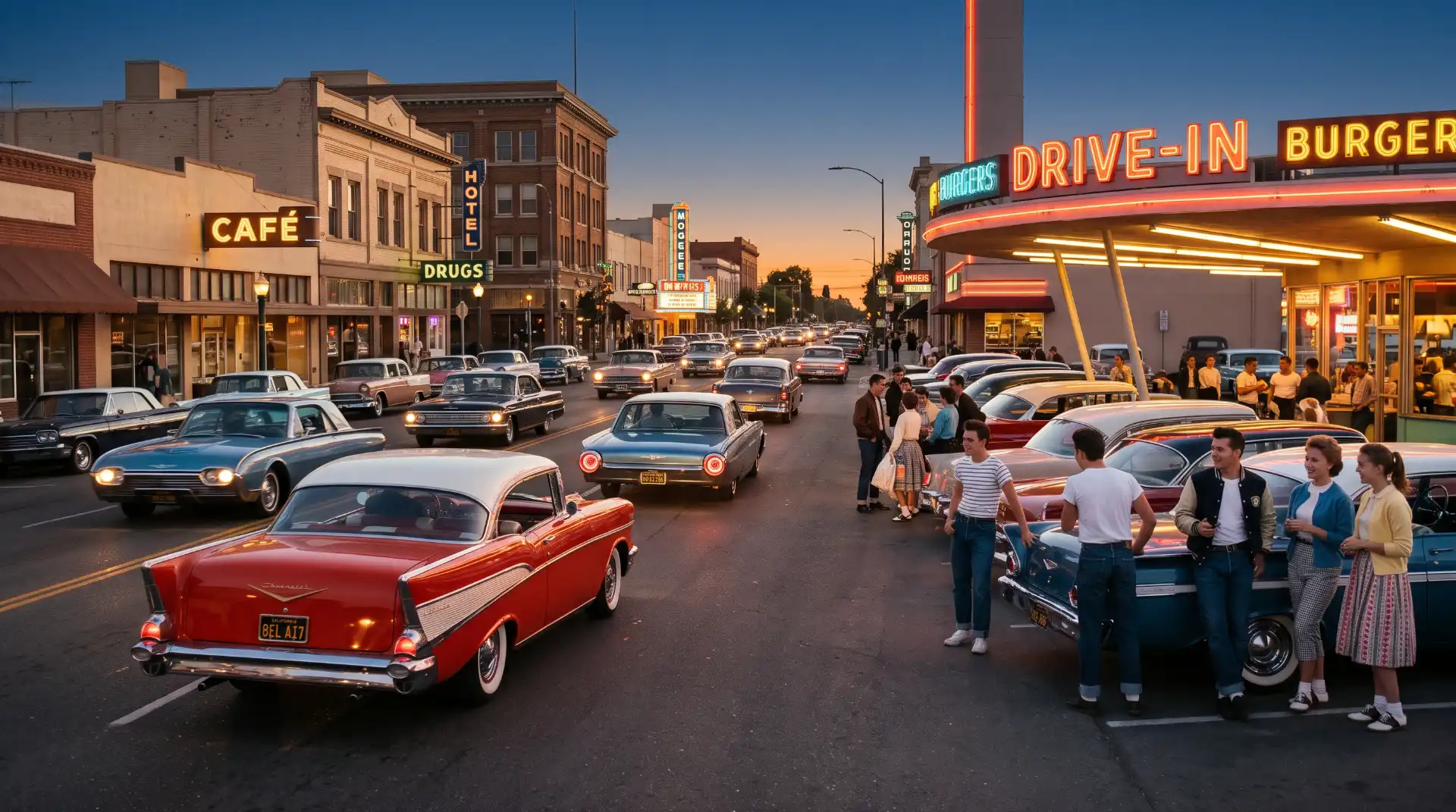
One of the most recognizable parts of Modesto’s early car culture was cruising, a social activity in which young drivers repeatedly traveled along popular streets, often following a familiar route and stopping at established gathering places.
In Modesto, this tradition became associated with the expression “Draggin’ Tenth.” The name referred to teenagers driving up and down 10th Street, making repeated passes through downtown while looking for friends, meeting other drivers, and enjoying the attention that came with owning or riding in a recognizable automobile.
Unlike modern transportation, where most drivers have a specific destination, cruising was often the destination itself. The experience involved seeing familiar faces, recognizing vehicles, listening to music, and participating in a shared community activity.
The traditional route connected downtown streets and local gathering places. Burge’s Drive-In, located at 1514 Ninth Street, near O Street, became one of the most important destinations. The business opened in 1947 and served generations of young customers before closing in 1967.
According to the Stanislaus County Library’s historical collection, the classic cruising era extended particularly from 1946 through 1962. Photographs preserved in the collection document local drive-ins, groups of teenagers, parked automobiles, and the continuing popularity of cruising into the following decade.
The early cruising route was not necessarily organized or formally managed. It developed through repeated use. Teenagers discovered where other young people gathered, and those locations gradually became recognizable destinations.
As more drivers participated, the streets themselves became part of the social environment. A young person might drive through downtown several times without leaving the vehicle, hoping to encounter classmates or friends. Another might park near a restaurant and spend the evening talking with other car enthusiasts.
This type of recreation was particularly appealing because it did not always require expensive entertainment. Gasoline, a working vehicle, and a few friends could provide an entire evening of activity.
For many teenagers, cruising became a weekly tradition that helped define their high school years.
3. Burge’s Drive-In: One of the Most Important Gathering Places
Few businesses represent the history of Modesto’s early cruising culture as clearly as Burge’s Drive-In. Located at 1514 Ninth Street, the restaurant became one of the central gathering places for young drivers during the late 1940s, 1950s, and early 1960s.
Burge’s opened in 1947 and remained in business until 1967. Its location near the downtown cruising area made it convenient for teenagers who wanted to stop for food while participating in the evening social scene.
The restaurant was more than a place to purchase hamburgers or refreshments. It functioned as an informal meeting point where people could recognize familiar vehicles, exchange news, meet friends, and watch the steady movement of automobiles.
Drive-in restaurants were especially suited to the automobile-centered lifestyle of the period. Customers could arrive in their cars, order food, and enjoy their meals without necessarily entering a traditional dining room. Parking areas became extensions of the restaurant’s social environment.
Burge’s also had an architectural appearance that reflected the period’s roadside commercial design. The Stanislaus Memory Project identifies it as an example of a circular Streamline Moderne-style drive-in. This style emphasized rounded forms and modern-looking structures that communicated speed, movement, and technological progress.
The restaurant’s position near old Highway 99 also made it part of a larger transportation landscape. Motorists traveling through Modesto could encounter businesses designed around the growing popularity of private automobiles.
Burge’s eventually became associated with the cultural memory of Modesto cruising because of its connection to George Lucas and American Graffiti. The restaurant served as the inspiration for Mel’s Drive-In in the film.
Although the original business no longer exists, historical photographs preserved by the Stanislaus County Library help document its appearance and importance. These images provide valuable evidence of a local business that played a significant role in the city’s postwar social history.
Burge’s story also illustrates why preserving photographs of ordinary commercial buildings is important. A restaurant that might once have appeared unremarkable can become historically significant because of the people who gathered there and the traditions that developed around it.
4. Al’s Drive-In and Felix’s Drive-In Along McHenry Avenue
Downtown Modesto was not the only area associated with the city’s early drive-in culture. As residential neighborhoods expanded, McHenry Avenue developed into another important commercial destination.
Two businesses frequently associated with this part of Modesto’s cruising history were Al’s Drive-In and Felix’s Drive-In.
Al’s Drive-In was located at 708 McHenry Avenue. Felix’s Drive-In was located at 203 McHenry Avenue and was operated by Leonard G. Felix after he sold Al’s Drive-In. Both locations became part of the city’s broader network of restaurants and gathering places.
These businesses reflected the changing geography of Modesto. As the population expanded and commercial development moved outward, young drivers increasingly had reasons to travel beyond the traditional downtown streets.
McHenry Avenue was especially important because it was becoming a major commercial corridor. Restaurants, shopping areas, service businesses, and other automobile-oriented establishments attracted customers who depended on private transportation.
For teenagers, these locations offered additional opportunities to socialize. Friends could arrange to meet at a familiar restaurant, drive between businesses, or spend time observing the vehicles that arrived throughout the evening.
The presence of several drive-ins also created a competitive social environment. Restaurants were not simply competing for food customers. Their parking lots and surrounding streets became recognizable places within the local youth scene.
The popularity of these businesses demonstrates how commercial development and youth culture influenced one another. Restaurants benefited from the increasing number of young drivers, while teenagers benefited from having convenient places to gather.
Al’s and Felix’s are now important parts of Modesto’s historical record, even though their original buildings and businesses have changed or disappeared.
Their stories are worth exploring alongside other locations discussed in Forgotten Places of Stanislaus County: Historic Sites Worth Remembering. The loss of an old building does not mean its contribution to community life should be forgotten.
5. The A&W Drive-In and the American Restaurant Experience
Another important business in Modesto’s automobile history was the A&W Drive-In at 1404 G Street, near 14th Street.
The location began as an A&W food stand in 1957 and became a drive-in restaurant in March 1958. Its opening reflected the popularity of roadside dining during a period when automobiles were becoming increasingly important to American social life.
A&W had a longer national history. The company began as a roadside root beer business in California in 1919 and expanded into restaurants that served hamburgers, hot dogs, root beer, and other familiar American foods.
The Modesto location offered the types of inexpensive refreshments that appealed to young customers. Historical advertisements reported prices including five-cent drinks, inexpensive hot dogs, and other affordable menu items.
The restaurant became particularly recognizable because of its traditional drive-in service. Customers could enjoy food near their vehicles, making the business a natural stopping point for people participating in the local cruising scene.
A&W also demonstrates how national restaurant trends influenced small and medium-sized California cities. Modesto was part of a much larger American movement toward roadside restaurants, drive-in service, and businesses designed around automobile access.
Unlike many older drive-ins, the G Street A&W continued to preserve important elements of its historical identity. It became a recognizable reminder of the era when teenagers could enjoy a meal, listen to music, and watch classic cars arrive throughout the evening.
The restaurant’s history is also connected to the city’s broader architectural heritage. The City of Modesto’s Historic Guide to Mid-Century Modern Architecture identifies the A&W at 1404 G Street as a 1957-era drive-in landmark.
The restaurant demonstrates that historical preservation does not always involve grand public buildings or famous monuments. Sometimes a modest roadside business can tell an important story about transportation, food, architecture, and community life.
6. Classic American Cars and the Meaning of Automobile Ownership
The automobiles driven through Modesto during the 1950s and 1960s were important parts of the city’s cultural identity. Cars represented engineering, personal taste, social status, and freedom.
American manufacturers were producing vehicles with increasingly distinctive styling. Large bodies, prominent chrome details, colorful paint, decorative trim, and powerful engines helped distinguish the automobiles of the period from earlier models.
Chevrolet, Ford, Pontiac, Buick, Cadillac, and Chrysler vehicles were familiar sights on American streets. Different models attracted different customers, and teenagers often developed strong preferences for particular makes and designs.
A Chevrolet Bel Air, for example, could become a source of pride for a young driver. A Ford Thunderbird offered a different image, combining sporty styling with an association with personal luxury. Pontiac models appealed to drivers interested in performance and distinctive design.
For young people, the appearance of a vehicle could be almost as important as its mechanical condition.
Paint color, wheels, tires, interior materials, exhaust sounds, and decorative accessories helped communicate personality. A clean, well-maintained vehicle could attract attention even if it was not particularly expensive.
Some teenagers inherited automobiles from relatives. Others purchased used vehicles and gradually improved them. A young driver might spend weekends washing a car, polishing chrome, repairing mechanical problems, or saving money for new accessories.
Automobile ownership also encouraged practical skills. Teenagers learned basic maintenance, checked engine fluids, changed tires, and became familiar with the operation of their vehicles. Friends sometimes helped each other repair engines or diagnose mechanical problems.
These activities created a social environment in which automobiles brought people together beyond the act of driving.
The car became a shared project, a hobby, and an important part of personal identity.
7. Hot Rods, Custom Cars, and the Growing Influence of Car Builders
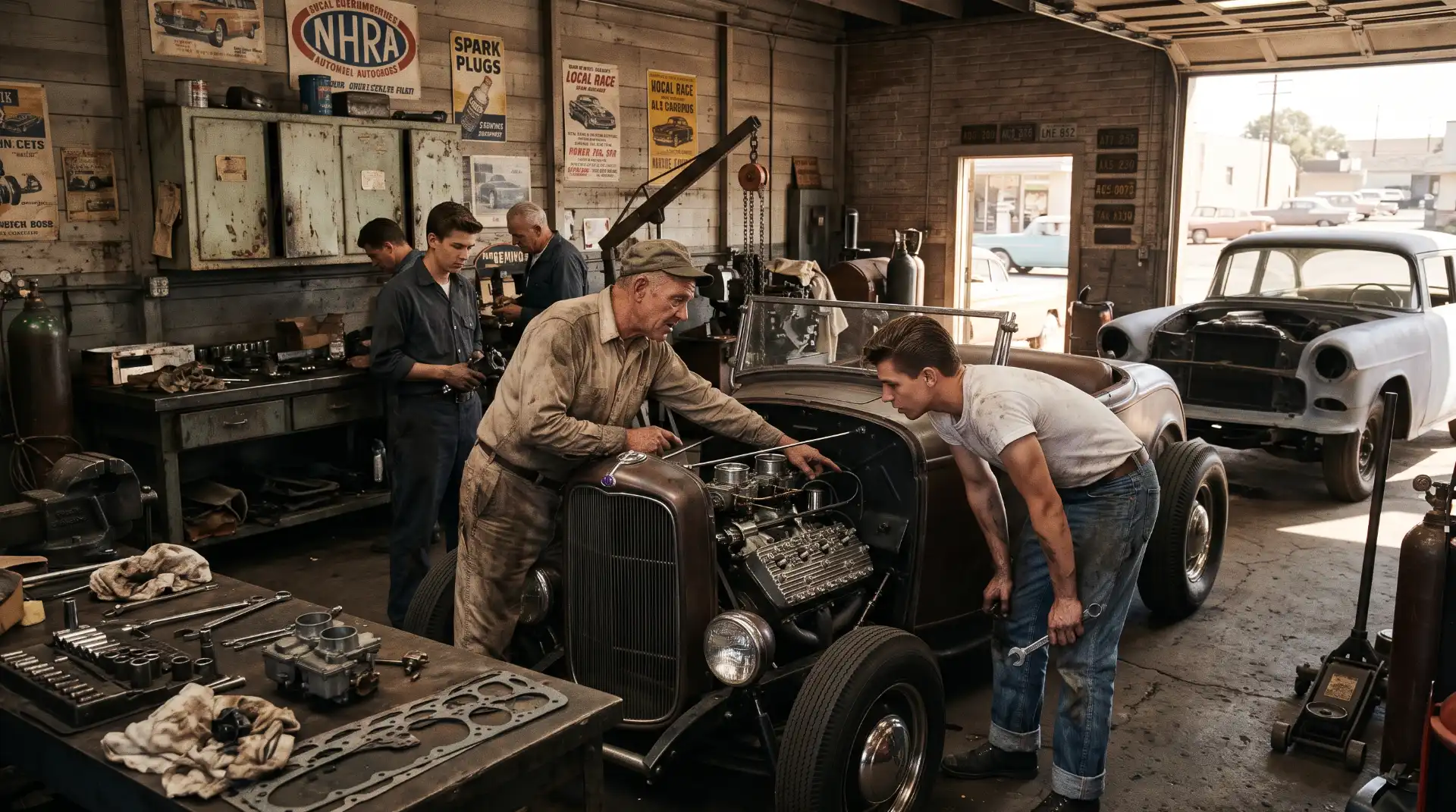
Modesto’s car culture was also connected to the wider California hot rod movement.
Hot rodding had developed before World War II, particularly among young automobile enthusiasts interested in modifying vehicles for greater speed and improved performance. After the war, returning veterans and younger mechanics helped expand the movement.
California became one of the most important centers of custom-car culture. The state’s expanding road network, automobile industry, automotive repair businesses, and growing population created an environment where car customization could flourish.
Modesto became associated with talented builders and customizers, including Gene Winfield, Marvin “Bart” Bartoni, and Pete Hischier. Their work helped establish the city as more than a place where teenagers simply drove around looking for entertainment.
Custom cars required creativity and technical knowledge. Builders modified body panels, improved engines, adjusted suspensions, developed custom paint schemes, and created interiors that reflected individual tastes.
Some modifications emphasized speed, while others focused on appearance. Certain vehicles were designed to look elegant and distinctive, while others reflected the aggressive styling associated with hot rods.
Local automotive enthusiasts also learned from magazines, car shows, repair shops, and conversations with other builders. Knowledge circulated through friendships and the wider automotive community.
For teenagers, watching experienced mechanics work on customized vehicles could be inspiring. A young person who initially became interested in cars through cruising might eventually learn welding, painting, engine repair, or bodywork.
This connection between driving and craftsmanship remains an important part of the history of Modesto’s automotive identity.
8. Teenage Life, High Schools, Dating, and Social Independence
The automobile changed more than transportation. It influenced how young people experienced school, friendships, dating, and independence.
During the 1950s and 1960s, high school students increasingly participated in activities outside the classroom. School dances, sporting events, social gatherings, and weekend entertainment created opportunities for teenagers to develop friendships and relationships.
For students who had access to automobiles, cruising provided another way to participate in social life.
A young driver could pick up friends, travel downtown, visit a drive-in, and return home later in the evening. This independence was particularly meaningful for teenagers who previously depended on parents or other adults for transportation.
Cars also influenced dating traditions. Going to a restaurant, attending a movie, or taking a drive became familiar parts of teenage courtship. A vehicle offered privacy and freedom, although parents often established rules about where teenagers could go and when they needed to return.
The experience was not identical for everyone. Some students had access to family automobiles, while others depended on friends or waited until they could afford their own vehicles. Economic circumstances influenced who could participate regularly.
School identity also played a role. Students from different high schools and neighborhoods could encounter one another through the cruising scene. Local gathering places helped create connections that crossed school boundaries.
The history of Stanislaus County’s Historic Schools: The Stories Behind Their Names offers useful context for understanding the educational communities in which these young people grew up.
The automobile did not replace school activities or traditional friendships. Instead, it expanded the places where teenagers could meet and socialize.
For many former residents, memories of cruising are closely connected to the people they knew during high school. A particular car, restaurant, or street corner can bring back memories of friendships, first dates, school celebrations, and the excitement of becoming an adult.
9. Rock and Roll, Radio, and the Soundtrack of Cruising
Cars provided the transportation, but music supplied much of the atmosphere.
The 1950s witnessed the growing popularity of rock and roll, a musical movement that transformed American popular culture. Artists such as Elvis Presley, Chuck Berry, Little Richard, and Buddy Holly became influential figures among young listeners.
Their music was energetic, rhythmic, and closely associated with teenage independence.
For young drivers in Modesto, car radios made music an important part of cruising. A group of friends could travel through downtown while listening to popular songs, discussing new records, or turning up the volume when a favorite track played.
Radio connected local teenagers with national culture. Even though Modesto was a Central Valley city, its young people could listen to the same popular music being played in Los Angeles, San Francisco, Sacramento, and other American communities.
The early 1960s brought additional musical changes. The popularity of surf music, vocal groups, and the British Invasion introduced new sounds and styles.
Music also became part of the identity associated with particular cars. A vehicle with a powerful radio and quality speakers could become a mobile entertainment space.
For teenagers, the combination of cars and music created an experience that was different from traditional family entertainment. Young people could choose their own songs, spend time with friends, and move between social locations without requiring a formal event.
This relationship between music and automobile culture later became one of the defining characteristics of American Graffiti.
The movie’s soundtrack helped audiences understand the emotional importance of music during the early 1960s. Songs were not simply background entertainment. They represented memories, relationships, social attitudes, and the excitement of youth.
10. McHenry Village and the Expansion of Modesto’s Commercial Landscape
The changing geography of Modesto played a major role in the development of car culture.
During the early twentieth century, downtown was the city’s central commercial district. Many residents could reach stores, offices, and entertainment venues without traveling long distances.
However, postwar growth gradually changed this pattern.
New neighborhoods appeared outside the traditional downtown area. Families purchased homes in expanding residential districts, and businesses increasingly followed customers toward new commercial locations.
McHenry Avenue became one of the most important examples of this transformation.
McHenry Village opened in 1953 at the northern edge of Modesto. It represented a growing trend toward shopping centers designed to serve customers arriving by automobile.
Instead of concentrating all commercial activity downtown, businesses could now attract shoppers from surrounding residential neighborhoods through parking facilities and convenient road access.
For teenagers, these commercial developments also created new gathering opportunities.
Shopping areas and restaurant parking lots became places where young people could encounter friends and watch automobiles. As cruising expanded beyond downtown, these locations became increasingly important to the city’s social geography.
The movement toward automobile-oriented commercial development reflected a national trend. Across the United States, shopping centers, roadside restaurants, service stations, and suburban businesses increasingly depended on customers arriving by car.
Modesto’s experience was part of that larger transformation.
The automobile helped reshape where people shopped, where they ate, and where they spent their leisure time. It also contributed to the gradual shift of commercial activity away from older downtown streets.
11. Cruising Routes Changed as Modesto Grew
Modesto’s cruising tradition did not remain fixed in one location.
During the earliest period, downtown 10th Street was the best-known route. Burge’s Drive-In served as an important destination, and the surrounding streets provided the setting for repeated passes by teenage drivers.
However, the popularity of cruising eventually created practical challenges.
Large numbers of vehicles traveling along the same streets could cause congestion. Traffic patterns also changed as Modesto grew and city officials adjusted downtown street operations.
Historical accounts describe how changes to 10th and 11th Streets disrupted the original two-way cruising pattern in the late 1950s. Drivers adapted by establishing new routes.
As the city’s commercial geography expanded, cruising also moved toward McHenry Avenue and other locations.
By the 1960s, the activity involved more than one downtown loop. Restaurants, shopping centers, and commercial parking areas became part of the larger cruising environment.
This flexibility helped the tradition survive changes in the city.
The movement of cruising routes also provides an interesting way to study Modesto’s development. A street that once served as a central teenage gathering place could eventually become a busier transportation corridor. A restaurant that once attracted hundreds of young customers could disappear as commercial patterns changed.
The physical locations may have changed, but the memories associated with them remained important to former residents.
12. Graffiti Night and the Beginning of a Modesto Tradition
One of the most recognizable traditions associated with early Modesto cruising was Graffiti Night.
The term became associated with the excitement surrounding the end of the school year, when teenagers had more free time and could participate in extended cruising activities.
For many students, the first weekend after school ended represented the beginning of summer freedom.
Young drivers could spend more time with friends, stay out later, and participate in the local car scene without worrying about the next school day.
The gathering attracted attention because of the large number of vehicles involved. Drivers and passengers moved through familiar routes, while spectators watched the activity from sidewalks and business locations.
The tradition became so closely associated with Modesto that it eventually developed into an important part of the city’s cultural identity.
Graffiti Night also reflected a wider social change. During the 1950s and 1960s, American teenagers were becoming an increasingly visible consumer and cultural group. Music companies, clothing manufacturers, restaurants, movie theaters, and automobile businesses all recognized the importance of young customers.
Modesto’s cruising scene demonstrated how a local community could develop its own distinctive version of this national youth culture.
What began as an informal social activity gradually became a recognizable local tradition.
13. George Lucas and the Connection to American Graffiti
Modesto’s early car culture received international attention because of filmmaker George Lucas.
Lucas was born in Modesto and spent his youth in the area. His experiences growing up in the city helped inspire the atmosphere and characters of American Graffiti, released in 1973.
The film portrays a group of young people spending an evening cruising through town while considering their futures, relationships, and personal ambitions.
Although the movie is fictional, its setting and social atmosphere were influenced by Lucas’s memories of Modesto during the early 1960s.
The film captured several recognizable elements of the local car culture: teenage drivers, drive-in restaurants, customized vehicles, popular music, and the importance of familiar streets.
It also explored a broader theme involving the transition from adolescence to adulthood.
The characters are approaching important decisions about education, relationships, employment, and leaving their hometown. Their evening of cruising becomes a symbolic moment before their lives begin to change.
Lucas’s connection to Modesto gave the movie an especially strong local identity.
According to Lucasfilm, American Graffiti celebrates the early 1960s and was inspired by Lucas’s youth in the San Joaquin Valley community where he grew up.
The film was not shot entirely in Modesto, and its fictional locations should not be confused with actual filming locations. Nevertheless, the city’s cruising tradition provided an important foundation for its atmosphere.
For additional background, readers can visit the official Lucasfilm page for American Graffiti.
The film helped introduce audiences around the world to a particular vision of small-town American youth culture.
For Modesto, it created an enduring connection between the city’s history and one of the most recognizable movies about teenage life in the 1960s.
14. The Changing Experience of Cruising During the 1960s
Although the early 1960s are often remembered as the classic period of Modesto cruising, the tradition continued to evolve.
As the decade progressed, the city’s population increased and commercial development expanded. More drivers entered the transportation system, and familiar gathering places changed.
The automobiles themselves also evolved.
Muscle cars became increasingly popular during the middle and later years of the 1960s. Models such as the Pontiac GTO, Chevrolet Chevelle SS, Ford Mustang, and Dodge Charger appealed to drivers interested in performance and distinctive styling.
These vehicles reflected changing preferences among American car buyers.
Compared with many large automobiles of the early 1950s, muscle cars emphasized acceleration, engine performance, and a sportier image.
Young drivers who enjoyed cruising could now encounter a wider variety of vehicles, from customized older cars to newer performance models.
Music changed as well. The 1960s introduced new musical movements and changing attitudes toward fashion, relationships, politics, and social identity.
As a result, the cruising environment of the later 1960s was not identical to the world remembered from 1962.
Modesto was experiencing the same broader cultural changes affecting other American cities. The early cruising era remained an important memory, but the community was continuing to develop.
15. The Social Challenges of Cruising and Changing City Regulations
Cruising was an important form of youth recreation, but it was not always welcomed by everyone.
As participation increased, residents and businesses sometimes experienced traffic congestion, noise, parking difficulties, and disturbances associated with large gatherings.
These concerns became more noticeable as Modesto grew.
For teenagers, cruising was often a harmless social activity centered on automobiles, music, and friendships. For residents living near popular routes, repeated traffic and late-night noise could become frustrating.
Local officials faced the challenge of balancing recreation with neighborhood concerns and public safety.
The tension between cruising enthusiasts and city residents did not disappear after the 1960s. It continued into later decades and eventually became a major issue in local government discussions.
In 1990, Modesto adopted anti-cruising and anti-loitering ordinances. The debate received national attention because the city had become closely associated with American Graffiti.
This later controversy is important because it demonstrates that cruising was not simply a nostalgic activity. It was a living community tradition that continued to influence public policy and urban life long after the original 1950s and 1960s period.
The story also reveals how historical activities can change meaning over time. What one generation remembers as an enjoyable teenage tradition may become a complicated issue when a city grows and its transportation needs change.
A balanced history should recognize both sides: the cultural importance of cruising and the practical challenges associated with managing large gatherings on public streets.
16. What Happened to the Original Drive-In Restaurants?
As Modesto continued growing, many of the businesses associated with early cruising gradually disappeared.
Burge’s Drive-In closed in 1967, marking the end of an important chapter in the history of the city’s original downtown cruising scene. Al’s and Felix’s also became part of the city’s commercial past as businesses and transportation patterns changed.
Several factors contributed to the disappearance of historic drive-ins. Commercial development moved toward newer shopping areas, restaurant designs changed, and competition from fast-food chains transformed the American dining industry.
Some businesses closed because of changing ownership or financial circumstances. Others lost customers as familiar gathering places became less popular or as cruising routes shifted.
The disappearance of these restaurants is significant because they represented more than individual businesses. They were social institutions that helped shape teenage experiences.
A restaurant parking lot could be a meeting place, a dating destination, a place to show off a newly purchased vehicle, or simply somewhere to spend time with friends. When these locations disappeared, part of the physical environment that supported the original cruising tradition disappeared with them.
Fortunately, historical photographs have helped preserve their memory.
The Stanislaus County Library’s Stanislaus Memory Project maintains a collection dedicated to local graffiti and cruising history. Its collection includes photographs of Al’s Drive-In, Burge’s Drive-In, Felix’s Drive-In, and local cruising activity.
The collection is especially valuable because it documents everyday places and experiences that might otherwise have received little attention from historians.
Readers interested in researching the original businesses can explore the Stanislaus Memory Project’s Graffiti and Cruising Collection.
17. The Importance of Modesto’s Historic Streets and Buildings
The history of early Modesto car culture is closely connected to the city’s physical development.
Downtown streets, commercial buildings, restaurants, parking areas, and transportation routes created the environment where cruising became popular.
Some historic locations have disappeared, while others remain recognizable parts of the community.
The Modesto Arch is one example of a downtown landmark that provides historical context for the changing city. Although it predates the cruising era by several decades, it represents the older downtown environment through which generations of residents traveled.
During the 1950s and 1960s, teenagers driving through the city would have encountered an urban landscape shaped by earlier agricultural, railroad, and commercial development.
The history of The Modesto Arch: How a Local Landmark Became a Symbol helps explain how downtown developed before the automobile became such an important part of local social life.
Historic streets are particularly valuable because they connect different periods of community history. A road that once carried horse-drawn wagons, delivery trucks, and early automobiles might later become a popular cruising route.
Preserving the stories associated with these locations helps residents understand how Modesto changed from a smaller agricultural community into a growing Central Valley city.
18. How to Research Your Family’s Modesto Cruising History
For people whose parents or grandparents grew up in Modesto during the 1950s and 1960s, early car culture can be an interesting subject for family research.
Many former residents still remember the automobiles they owned, the restaurants they visited, and the streets where they spent their weekends.
These personal memories can help historians reconstruct experiences that are not always fully documented in official records.
Family photographs are an excellent starting point. An old picture of a Chevrolet parked outside a restaurant may reveal the vehicle’s model, the appearance of a business, or the location of a gathering place.
Photographs taken during school years can also provide clues about the social environment. Images of graduation celebrations, teenage gatherings, car clubs, and family outings may help establish when and where certain activities took place.
Newspaper advertisements and business announcements are another useful source. Historical advertisements can identify restaurant locations, opening dates, menu prices, and promotional events.
Yearbooks can provide additional information about teenage life. They sometimes include photographs of students with automobiles, advertisements from local businesses, and references to popular activities.
The following research methods can help families preserve their stories:
-
Interview relatives who lived in Modesto during the 1950s and 1960s.
-
Identify the make, model, and approximate year of automobiles appearing in family photographs.
-
Look for restaurant advertisements in historical newspaper archives.
-
Consult school yearbooks and graduation photographs.
-
Search library collections for images of historic Modesto streets and businesses.
-
Record the names of friends, family members, car clubs, and businesses mentioned in family stories.
When interviewing older relatives, it is useful to ask specific questions rather than simply asking whether they remember cruising.
For example, ask which street they traveled, what restaurant they visited, what car they drove, and which songs they listened to. Specific questions often encourage more detailed memories.
It is also important to distinguish personal recollections from verified historical information. A relative might remember a business operating during a particular year, but historical advertisements or photographs may provide a more precise date.
Combining oral histories with documentary evidence creates a stronger historical account.
19. Preserving Modesto’s Automotive Heritage for Future Generations
Modesto’s automotive history remains important because it represents a period when automobiles helped redefine American community life.
The cars, restaurants, streets, and music of the 1950s and 1960s were part of a larger cultural transformation. They reflected postwar prosperity, growing consumer independence, changing youth attitudes, and the increasing importance of private transportation.
Preserving this history requires more than maintaining a collection of classic automobiles.
Photographs of historic businesses are equally important. So are newspaper advertisements, family albums, personal letters, school yearbooks, car club records, and interviews with former residents.
These materials help explain why a particular restaurant became popular or why teenagers repeatedly traveled along one downtown street.
They also preserve the experiences of people who may never appear in major historical records.
A former restaurant employee might remember how many teenagers arrived on Friday nights. A mechanic might recall working on the cars that participated in local cruising. A former student might remember a particular summer evening when the downtown streets were crowded with familiar vehicles.
These experiences are valuable because community history is made up of ordinary people as much as famous individuals.
Local museums, libraries, historical organizations, schools, and families can all contribute to preserving the story.
One practical way to support historical preservation is to digitize old photographs and identify the people and places shown in them. A photograph with names, dates, and location information is much more useful to future researchers than an unidentified image.
Families can also donate copies of historically significant materials to local archives when appropriate, while retaining their original documents.
Preserving the history of Modesto’s cruising culture ensures that future generations can understand not only what the automobiles looked like but also what they meant to the people who drove them.
20. Modesto’s Continuing Connection to Classic Cars and Graffiti Culture
Although the original cruising environment of the 1950s and 1960s has changed, Modesto continues to celebrate its automotive heritage.
Classic-car gatherings, community events, historic cruise-route activities, and Graffiti Summer celebrations help maintain the connection between modern residents and the city’s automotive past.
These events bring together different generations of enthusiasts. Some participants personally remember the original cruising era, while younger visitors experience it through restored vehicles, historical photographs, music, and family stories.
The historic downtown cruise route is an especially important part of this connection.
The route associated with American Graffiti provides a way for residents and visitors to explore the places that helped define Modesto’s early car culture. Historical markers and community celebrations recognize the people and businesses associated with the tradition.
The Graffiti USA Classic Car Museum also works to preserve the broader cultural history of the period, including classic automobiles, rock and roll, radio, and the social experiences of the 1950s, 1960s, and 1970s.
This continued interest demonstrates that Modesto’s automotive identity is not limited to nostalgia for old cars.
It is also a way to preserve local identity, celebrate craftsmanship, recognize community traditions, and connect younger residents with the experiences of earlier generations.
A restored 1957 Chevrolet or an old photograph of Burge’s Drive-In can encourage conversations between grandparents and grandchildren about how the city once looked and how people spent their free time.
Those conversations are an important part of keeping local history alive.
21. The Different Experiences of Modesto’s Young Drivers
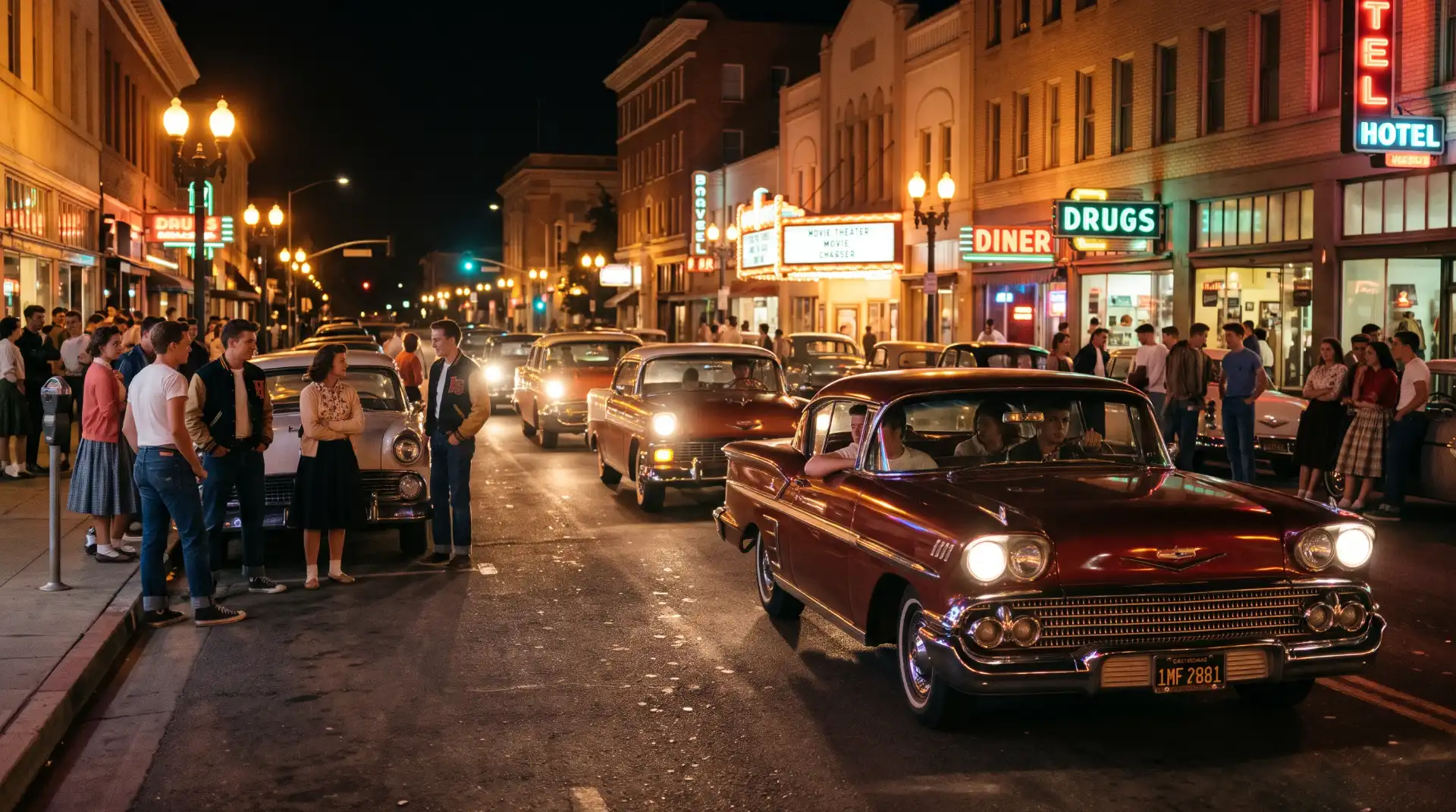
Although cruising is often remembered as a shared teenage experience, not every young person experienced it in the same way.
Access to automobiles depended heavily on family finances, employment opportunities, and personal circumstances. Some teenagers drove relatively new vehicles purchased by their parents, while others saved money to buy inexpensive used cars. Some depended on friends for transportation, and others participated in car culture through mechanical work, music, or attending gatherings.
This distinction is important when examining the history of youth culture. The ability to drive represented independence, but that independence was not equally available to everyone.
Modesto’s population also included families with different cultural backgrounds and economic experiences. Mexican-American families, agricultural workers, business owners, and other communities contributed to the city’s changing social environment.
Automobile culture developed within this broader community. Different groups could have their own preferences in music, vehicle styling, social activities, and ways of expressing identity.
Lowrider culture, for example, became an important form of Mexican-American automotive expression in California. Its emphasis on customized vehicles, distinctive paintwork, carefully designed interiors, and community pride developed its own cultural significance.
Lowriding should not be treated as identical to the hot rod and cruising traditions often depicted in American Graffiti. These automotive traditions sometimes overlapped, but they also had distinct histories and cultural meanings.
Recognizing these differences makes the history of Modesto’s car culture more complete. It prevents the story from becoming limited to one type of automobile, one social group, or one version of teenage life.
A fuller account should include the experiences of different neighborhoods, families, mechanics, business owners, and young drivers who contributed to the city’s automotive identity.
22. Why Modesto Became an Important Part of American Car Culture
Modesto was not the only American city where teenagers enjoyed cruising during the 1950s and 1960s. Similar activities developed in communities throughout California and across the United States.
What made Modesto particularly recognizable was the combination of its local cruising tradition, its association with George Lucas, and the international popularity of American Graffiti.
The city also had the physical characteristics that supported cruising. A compact downtown street network, popular drive-in restaurants, growing commercial corridors, and increasing automobile ownership created opportunities for repeated social gatherings.
Its location in the San Joaquin Valley also connected it to California’s broader automobile culture.
California had become an important center for automotive manufacturing, customization, racing, and recreational driving. Southern California hot rod traditions, Bay Area automotive businesses, and Central Valley car enthusiasts all contributed to a larger statewide culture.
Modesto developed its own identity within that environment.
The city’s experience illustrates how national cultural movements can take on distinctive local characteristics. Rock and roll was popular throughout America, but teenagers in Modesto experienced it through their own schools, restaurants, streets, friendships, and automobiles.
Similarly, classic cars were manufactured for national markets, but local drivers developed personal relationships with particular vehicles and gathering places.
This combination of national influence and local identity is one reason Modesto’s automotive history remains interesting to historians and enthusiasts.
The city did not invent teenage cruising, but it developed a tradition that became internationally recognizable.
23. What the Early Modesto Car Culture Teaches Us About Local History
The history of early Modesto car culture offers several important lessons about how communities change.
First, transportation can influence social relationships as much as economic development. Automobiles helped teenagers travel independently, meet friends, and participate in activities beyond their immediate neighborhoods.
Second, businesses can become important cultural landmarks even when their original purpose is relatively ordinary. Burge’s Drive-In and other restaurants became significant because of the social activities that developed around them.
Third, popular culture can preserve local history in unexpected ways. George Lucas’s experiences inspired a movie that later introduced international audiences to Modesto’s cruising tradition.
Finally, historical preservation should include everyday experiences. Local history is not limited to political leaders, major buildings, agricultural statistics, or significant public events. It also includes the restaurants where people ate, the vehicles they drove, the music they enjoyed, and the streets where they spent their evenings.
These everyday experiences help explain what life was actually like for residents during a particular period.
For Stanislaus County, the history of cruising also creates connections between different generations. Older residents can share memories of the original drive-ins, while younger generations can explore the same locations through photographs, historical records, and community events.
The result is a richer understanding of how Modesto developed its modern identity.
Conclusion: Remembering the Cars, Streets, and People of Early Modesto
The story of Modesto’s early car culture is ultimately a story about a generation growing up during a period of significant American change.
During the 1950s and 1960s, automobiles became central to teenage independence, social relationships, entertainment, and personal identity. Young people drove through downtown, gathered at restaurants, listened to rock and roll, admired customized vehicles, and developed traditions that became part of the city’s cultural heritage.
Burge’s Drive-In, Al’s Drive-In, Felix’s Drive-In, and the A&W on G Street were more than places to purchase food. They were gathering points where friendships developed and memories were created. Streets such as 10th Street and commercial corridors such as McHenry Avenue became recognizable parts of teenage life.
The popularity of cruising eventually extended beyond its original participants. George Lucas transformed memories of his hometown into American Graffiti, introducing audiences around the world to the atmosphere of early 1960s Modesto.
Today, the original restaurants and many familiar locations have disappeared or changed. However, photographs, historical collections, restored automobiles, community celebrations, and personal memories continue to preserve their importance.
For anyone exploring Stanislaus County history, early Modesto car culture provides a valuable reminder that local history is often found in ordinary places. A drive-in restaurant, an old automobile, a downtown street, or a favorite song can reveal something meaningful about an entire generation.
The cars may no longer travel along the original cruising route every weekend, but the memories of those evenings remain an important part of Modesto’s identity.