
Stanislaus County is often recognized for agriculture, orchards, dairy farms, busy highways, and growing Central Valley communities. Yet beneath the modern landscape is a much older story. Long before today’s neighborhoods, shopping centers, industrial areas, and expanding roads appeared, the region was shaped by Indigenous communities, gold seekers, farmers, railroad workers, merchants, immigrants, and families who built towns along rivers, roads, rail lines, and irrigation systems.
Some of the most important chapters in that story are connected to places that are easy to overlook.
A road may pass through a former mining community without revealing what once stood there. An old building may look ordinary even though it served generations of residents. A quiet stretch of land may contain remnants of an earlier agricultural settlement. In other cases, the physical structures are gone, leaving behind only historical records, photographs, archaeological evidence, markers, or stories preserved by local organizations.
That is why remembering Stanislaus County’s historic places matters. Historic preservation is not only about maintaining impressive buildings. It is also about understanding the communities, industries, families, and events that helped create the region.
The McHenry Museum & Historical Society has documented numerous historically significant locations throughout Stanislaus County, while the California Office of Historic Preservation recognizes several communities and properties through state historical landmarks and points of interest. Stanislaus County’s own historical-resource documentation also identifies numerous sites connected with the county’s development.
This article explores several historic places and communities worth remembering and explains what they reveal about the history of California’s Central Valley.
Why Stanislaus County’s Forgotten Places Matter
History is often associated with famous landmarks, museums, monuments, and preserved houses. Those places are important, but they represent only part of the historical landscape.
Many stories are connected to places that changed dramatically or disappeared entirely.
Stanislaus County developed through several overlapping forces. Indigenous communities lived throughout the Central Valley long before American settlement. Gold mining brought new settlers into the region during the nineteenth century. Agriculture expanded as irrigation infrastructure developed. Railroads connected communities with markets outside the valley. Small towns developed around mills, farms, ranches, schools, churches, stores, and transportation routes.
The landscape continued to change throughout the twentieth century.
Some communities expanded into cities. Others remained small. Some historic buildings survived, while others were demolished, remodeled, relocated, or simply disappeared. The result is a county where modern development exists alongside fragments of an older landscape.
Looking for these forgotten places can provide a different way of understanding Stanislaus County. Instead of seeing history as a list of dates, visitors can see how geography, transportation, agriculture, water, and community life influenced where people lived and worked.
Knights Ferry: A Gold Rush Community Along the Stanislaus River
One of the most important historic communities in eastern Stanislaus County is Knights Ferry.
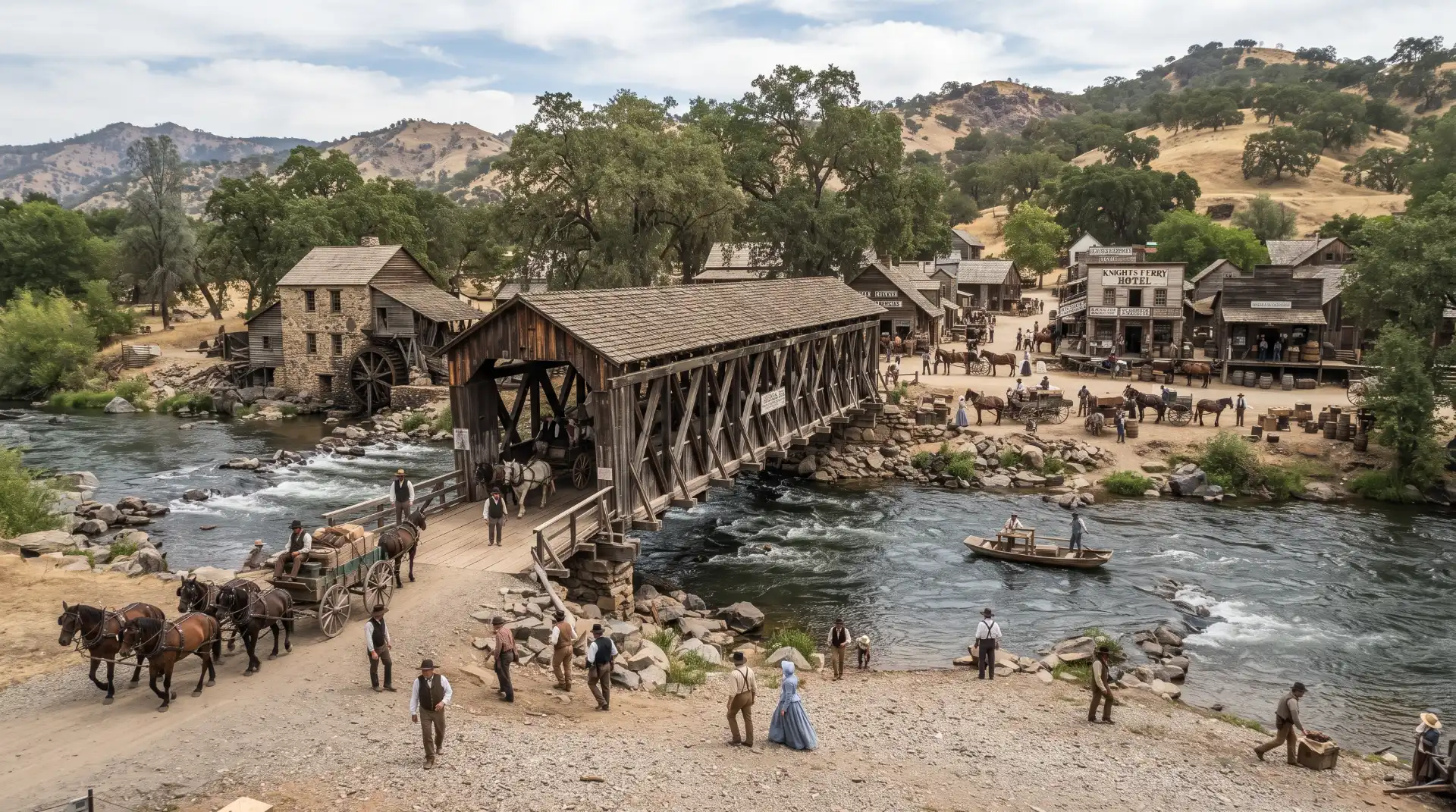
Today, Knights Ferry is known for its scenic setting along the Stanislaus River and its historic structures. But its origins reach back to the Gold Rush era. The California Office of Historic Preservation identifies Knights Ferry as State Historical Landmark No. 347 and notes that the community was founded in 1849 as Dentville. It developed as a mining center and trading post, with an early ferry serving travelers heading toward the southern mining regions.
The community’s location was important.
Rivers could be obstacles for travelers, but they could also become centers of transportation and commerce. A crossing point could attract miners, merchants, farmers, teamsters, and other travelers. Over time, businesses and services could develop around that transportation route.
Knights Ferry also preserves an important connection to nineteenth-century engineering. The historic covered bridge and flour mill are among the structures associated with the community’s early development. According to California’s historic-landmark documentation, the wooden covered bridge and old flour mill date to the 1850s.
The community also served as the county seat from 1862 to 1872.
That detail alone demonstrates how different the county’s geographic and political landscape once was. Today, many residents may associate Stanislaus County’s civic identity primarily with Modesto and other larger communities. In the nineteenth century, however, the county seat shifted as settlements developed and regional priorities changed.
Knights Ferry therefore offers more than a picturesque historic setting. It provides a window into the Gold Rush economy, river transportation, early government, and the development of communities outside today’s major population centers.
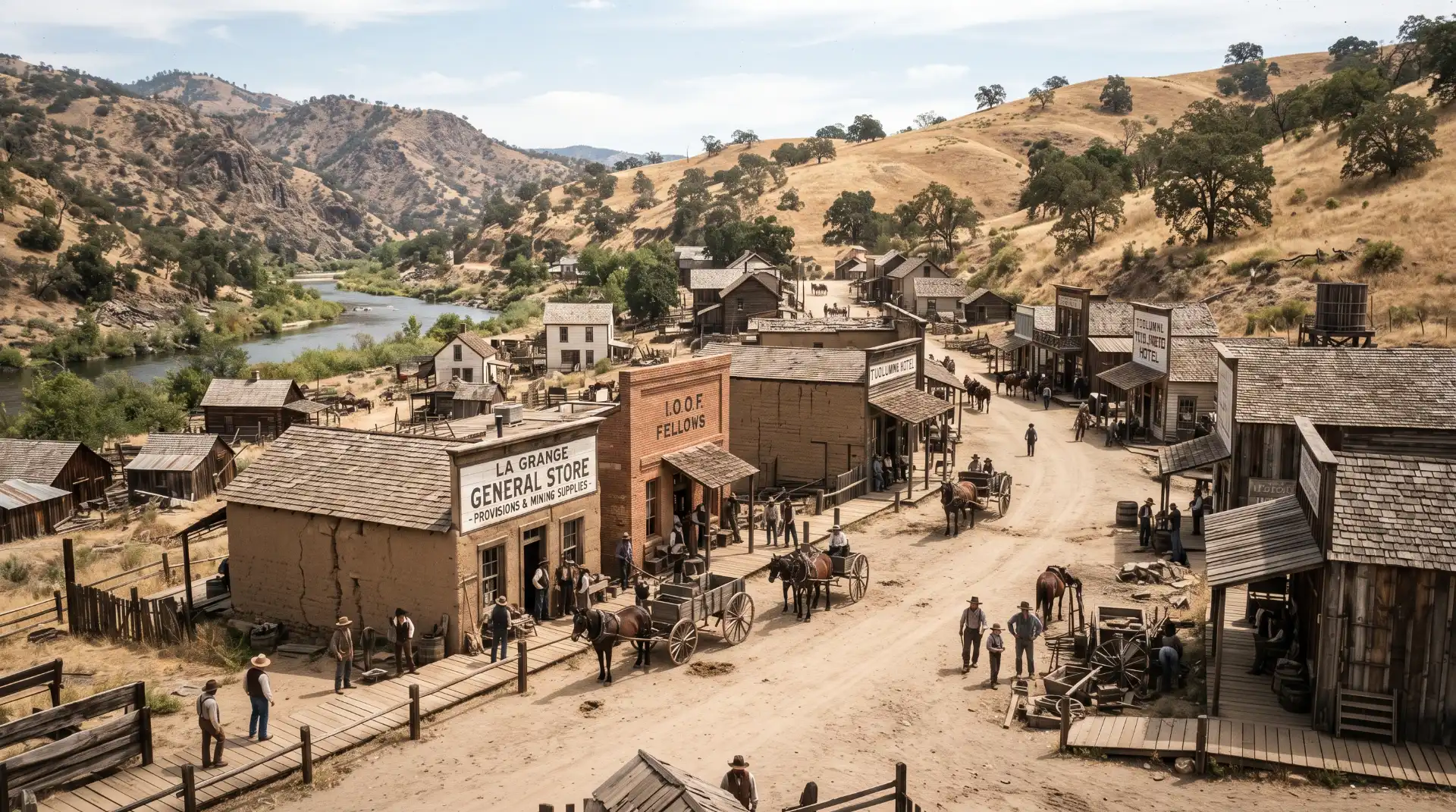
La Grange: From French Bar to an Early County Seat
Another historic community that deserves attention is La Grange, located along the Tuolumne River.
The community began as French Bar, established by French settlers in 1850. Flooding during 1851–1852 forced residents to relocate to higher ground, where the community was renamed La Grange. The California Office of Historic Preservation identifies La Grange as State Historical Landmark No. 414 and notes that it became both a mining and agricultural community.
La Grange served as the county seat from 1856 to 1862.
The community’s history illustrates how quickly California settlements could change during the Gold Rush period. Mining initially attracted people and investment, but agriculture increasingly became part of the region’s economic foundation.
That transition is important when looking at Stanislaus County as a whole.
The county’s history was never exclusively about agriculture or exclusively about mining. These economic activities overlapped and influenced one another. Communities developed along waterways and transportation routes, while farmers and ranchers supplied growing populations.
La Grange is therefore an important reminder that the Central Valley’s modern agricultural identity emerged from a much more complicated nineteenth-century landscape.
Historic resources associated with La Grange have included buildings and structures connected with early commercial, civic, religious, educational, and transportation activities. County historical-resource documentation lists sites such as the Kingen Hotel, Odd Fellows Hall, Old Adobe Barn, Old La Grange Schoolhouse, St. Louis Catholic Church, Stage Stop, and other historic properties in the community.
Even when a historic structure is no longer used for its original purpose, the location can help tell the story of how the community developed.
The La Grange Gold Dredge and the Mining Landscape
The Gold Rush did not end when the most famous mining discoveries faded from public attention.
Mining continued to influence parts of the Central Valley and Sierra foothills for decades. The La Grange area became associated with large-scale gold dredging, creating another chapter in the region’s mining history.
The historic Gold Dredge site is particularly valuable because it helps explain the technological changes that transformed mining. Gold extraction evolved from individual prospectors using relatively simple tools to increasingly industrial operations involving large machinery.
The Stanislaus County Historical Society’s archival history records its involvement in efforts connected with the acquisition of lands for the La Grange Gold Rush Park and preservation of the gold dredge. Historical Society activities also included visits to the ghost town associated with the Gold Dredge Historic Site.
The story is important because it shows how technology changed the physical landscape.
Large mining operations could move enormous quantities of soil and sediment. They also required workers, transportation, supplies, and infrastructure. Their presence affected nearby communities and became part of the economic history of the region.
For visitors interested in California’s Gold Rush, places such as La Grange demonstrate that gold-mining history extends well beyond the famous destinations usually associated with the Sierra Nevada.
Tuolumne City: A Community Remembered in the Historical Record
Another name worth remembering is Tuolumne City.
Modern residents traveling through Stanislaus County may encounter roads, agricultural areas, and communities that give little indication of the settlement patterns that existed during the nineteenth century.
Historical documentation identifies Tuolumne City as a point of interest associated with Stanislaus County’s early history.
Its story belongs to the larger pattern of settlement along rivers and transportation corridors.
Early communities depended heavily on access to water, transportation, and agricultural land. A location that was strategically important in one period could lose importance when transportation routes shifted, flooding occurred, industries changed, or larger communities grew.
This is one reason historical maps and old records are so valuable. They can reveal communities and places that are no longer prominent on today’s maps.
The story of Tuolumne City also reminds us that not every historic location survives as a recognizable downtown or collection of preserved buildings. Sometimes its importance exists primarily through documentation, archaeological evidence, historic markers, photographs, maps, and written accounts.
Hughson and the Agricultural Transformation
Hughson provides a different kind of historical story.
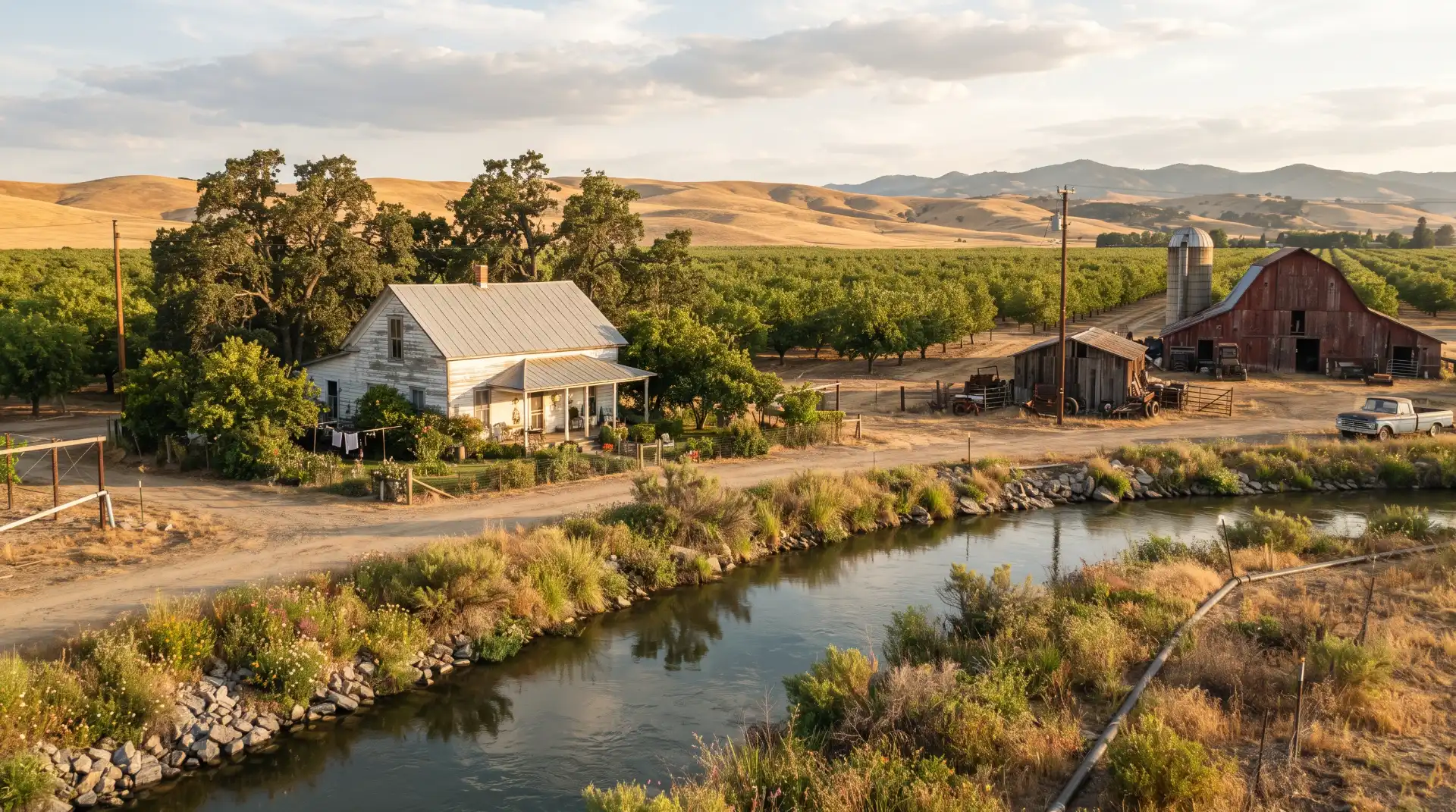
Rather than being remembered primarily as a Gold Rush settlement, Hughson’s history demonstrates how irrigation and agriculture transformed the Central Valley.
The Hughson Historical Society explains that grain was an important early crop, while later irrigation development helped farmers expand into alfalfa, cattle, fruits, and vegetables. Peaches became especially important during the twentieth century, and Hughson became known for its peach industry.
This agricultural transformation reflects a much larger regional pattern.
Water infrastructure changed what farmers could grow and how intensively land could be cultivated. Irrigation projects helped make orchards and diversified agriculture increasingly viable across parts of Stanislaus County.
The story also shows that agriculture was not simply about what grew in the soil. It involved transportation, processing, storage, packing, markets, labor, and commercial relationships.
Hughson’s historic agricultural identity therefore belongs to the history of the entire Central Valley.
When visitors see modern orchards or farm stands, it can be easy to think of them as simply part of the present-day landscape. In reality, many agricultural communities have developed over generations, with today’s farms connected to earlier patterns of settlement and production.
The Turlock Assembly Center and a Difficult Chapter of American History
Not every historic site tells a story that is easy to remember.
The Turlock Assembly Center is associated with one of the most difficult chapters in United States history: the forced removal and incarceration of Japanese Americans during World War II.
Stanislaus County historical-resource documentation identifies the Turlock Assembly Center as a State Historical Landmark.
The site is important because local history cannot be separated from national history.
During World War II, Japanese Americans were forcibly removed from their homes under federal policy and confined in temporary assembly centers before many were transferred to more permanent incarceration camps.
Remembering the Turlock Assembly Center helps connect Stanislaus County to this national history and provides an opportunity to discuss civil liberties, wartime policy, discrimination, and the experiences of families affected by incarceration.
For a history-focused website, this is particularly important. Preserving local history does not mean focusing only on stories that are comfortable or celebratory. Communities also have a responsibility to preserve difficult histories so that future generations can study what happened and understand its consequences.
The story of the Turlock Assembly Center is therefore part of Stanislaus County’s history and part of the broader history of the United States.
Old Schools and Community Buildings
Some of the most meaningful historic places are not grand landmarks.
An old schoolhouse, meeting hall, church, post office, or neighborhood store can reveal how communities functioned in earlier generations.
County historical documentation includes properties such as the Old La Grange Schoolhouse, Odd Fellows Hall, churches, libraries, and other community structures.
These buildings served practical purposes, but they also became gathering places.
A school was more than a classroom. It could be one of the few places where children from nearby families met regularly. A church could serve as both a religious institution and a center of social life. A fraternal hall could provide meeting space for organizations and community activities.
Historic buildings therefore preserve more than architectural styles. They can preserve evidence of how people organized their lives.
This is one reason local historic preservation surveys are valuable. A building that seems ordinary today may have considerable historical importance when viewed in the context of its neighborhood and time period.
A historic building survey of Modesto conducted for the Stanislaus County Historical Society examined cultural resources dating from 1870 through 1942, including commercial, public, domestic, and district-level resources. The survey emphasized the importance of creating greater public awareness of the area’s architectural heritage and encouraging preservation and appropriate reuse.
Modesto’s Historic Places Are Part of the Larger Story
Although this article focuses on places that can be overlooked, Modesto contains many well-known historic landmarks that help anchor the county’s broader story.
The McHenry Museum and McHenry Mansion are among the most recognizable. The McHenry Museum’s exhibits cover subjects including Indigenous history, gold mining, the founding of Modesto by the railroad, irrigation, agriculture, historic occupations, and everyday life.
The museum itself has an interesting history. The building originally served as the McHenry Library before being transformed into the McHenry Museum in the early 1970s.
Other Modesto landmarks documented by the city include the Modesto Arch, Hawke Castle, the Southern Pacific Transportation Center, historic homes, bridges, public buildings, and other structures.
These places matter because they provide physical connections to different periods of the city’s development.
But they also provide a starting point for exploring lesser-known stories.
A visitor who learns about Modesto’s railroad history, for example, can begin asking how rail transportation influenced smaller towns. Someone studying irrigation can explore how water transformed agricultural communities. Someone interested in historic architecture can investigate why certain building styles became common in the Central Valley.
In this way, the most recognizable landmarks can lead to the forgotten ones.
The Railroad’s Role in Shaping Stanislaus County
Transportation is one of the recurring themes in Stanislaus County history.
The arrival and expansion of railroads changed how agricultural communities connected with markets. Crops could be transported more efficiently, towns could attract businesses, and residents could travel farther from home.
Modesto itself was founded in connection with the railroad, a history represented in the McHenry Museum’s permanent exhibits.
Rail transportation also affected smaller agricultural communities.
Hughson’s historical development, for example, was closely connected with the movement of agricultural products. The town’s peach industry relied not only on growers but also on receiving, processing, transportation, and commercial infrastructure.
This is an important reminder that historic landscapes are interconnected.
A farm was never completely isolated from the rest of the county. It depended on roads, railroads, irrigation systems, labor, markets, packing facilities, and nearby communities.
Understanding those connections makes it easier to appreciate why seemingly ordinary places can be historically significant.
Why Some Historic Places Disappear
Historic places disappear for many reasons.
Buildings deteriorate. Land values change. Roads are widened. Businesses close. Property owners replace older structures with newer ones. Floods, fires, earthquakes, and other disasters can destroy physical evidence.
Sometimes a building survives but its original function disappears.
A former school might become a private residence. A former commercial building might become an office. A railroad-related structure might lose its original use after transportation patterns change.
Other places disappear almost completely.
When that happens, photographs, maps, newspapers, oral histories, government records, museum collections, and historical societies become essential.
The McHenry Museum & Historical Society maintains research resources including historical publications and archival material designed to help the public research Stanislaus County’s past.
The Genealogical Society of Stanislaus County also works to support genealogical research and increase access to historical materials connected with the county and its residents.
These resources demonstrate that preservation is not limited to buildings. Documents and stories can be just as important.
Preserving History for Future Generations
Historic preservation can take many forms.
Sometimes preservation means protecting an entire building. Sometimes it means placing a historical marker at a site. In other cases, preservation involves documenting a property before it disappears.
Digital archives have also created new opportunities for local history.
Historic photographs can be scanned and shared. Old newspapers can be digitized. Oral histories can be recorded. Maps can be compared with modern geographic information. Families can contribute photographs and documents to museums and historical organizations.
These efforts make local history accessible to people who may never have had the opportunity to see an old building in person.
The Stanislaus County Historical Society has a long history of encouraging the identification of historic sites, preservation of structures, collection of historic photographs, and recording of local memories.
That work remains important because communities are constantly changing.
How Residents Can Explore Stanislaus County History
Exploring local history does not require a major trip.
A simple starting point is visiting a local museum or historical society. The McHenry Museum offers exhibits covering many aspects of Modesto and Stanislaus County history, including agriculture, irrigation, gold mining, Indigenous history, transportation, and everyday life.
Visitors can also explore historic communities such as Knights Ferry and La Grange, where surviving structures and historical landscapes provide physical connections to nineteenth-century California. California State Parks’ Office of Historic Preservation provides documented information about recognized historic landmarks in Stanislaus County.
Another useful approach is to compare old and modern maps.
Find an older map of Stanislaus County and look for roads, rail lines, settlements, rivers, canals, and communities that remain visible today. Then identify places that have changed or disappeared.
Local cemeteries can also offer valuable information about the people who lived in the region. Names, dates, occupations, and family relationships can reveal migration patterns and connections between communities.
Historic newspapers are another valuable source. Advertisements, school announcements, community events, business openings, agricultural reports, and local news can help reconstruct everyday life.
Perhaps most importantly, residents can talk with older family members and longtime community residents. Memories of former businesses, schools, farms, neighborhoods, and community traditions may contain information that never appeared in official records.
Remembering the Places Between the Famous Landmarks
The history of Stanislaus County is not limited to its most famous landmarks.
It is also found in former mining settlements, agricultural communities, old transportation routes, schools, churches, farm properties, railroad-related locations, river crossings, and places where only fragments of the past remain.
Knights Ferry tells the story of Gold Rush transportation and river commerce. La Grange connects mining, agriculture, early government, and settlement. Hughson illustrates the transformation of Central Valley agriculture through irrigation and fruit production. The Turlock Assembly Center connects a local site to one of the most difficult chapters of American history.
Together, these places show how complicated local history can be.
They also demonstrate why preservation matters.
A historic place does not need to be famous to be meaningful. A structure does not have to be grand to deserve attention. A forgotten community does not cease to matter simply because modern development has changed the surrounding landscape.
Stanislaus County’s history was built by thousands of people whose daily work shaped the communities that exist today. Farmers planted crops. Railroad workers connected towns to markets. Merchants established businesses. Families built homes. Students attended small schools. Immigrants established communities. Indigenous peoples maintained longstanding connections to the land. Workers powered industries that helped the region grow.
Many of their stories remain embedded in the places around us.
A Living History Worth Remembering
Historic preservation is ultimately about more than looking backward.
Understanding the past helps communities recognize how today’s landscape came to exist. Roads, towns, farms, neighborhoods, waterways, and public buildings all have histories. Some are well documented, while others require deeper research.
For Stanislaus County, those stories are especially important because the region has experienced significant agricultural, industrial, transportation, and population changes over time.
The county’s historic places provide opportunities to slow down and look more closely.
An old building can raise questions about the people who used it. A former railroad route can reveal how goods and people once moved. An agricultural community can demonstrate the importance of water and irrigation. A mining settlement can show how quickly California communities developed during the Gold Rush.
Even places that have disappeared can still be remembered through photographs, records, maps, museum collections, and oral histories.
That is why the forgotten places of Stanislaus County are worth remembering.
They are not simply remnants of another era. They are pieces of the story that explains how the Central Valley became what it is today.
For anyone interested in learning more, the California Office of Historic Preservation provides authoritative information about California’s historic landmarks and recognized cultural resources, while the McHenry Museum & Historical Society offers local research materials and exhibits focused on Modesto and Stanislaus County history.
The more we document, explore, and share these stories, the less likely they are to disappear.
Stanislaus County’s history is not only found in the places that remain. It is also found in the places that have changed, faded, or vanished—and those forgotten places are worth remembering.