
The Modesto Arch is one of the most recognizable historic landmarks in Modesto, California. Standing over Ninth and I Streets in the heart of downtown, the structure has welcomed residents and visitors for more than a century. Its large “MODESTO” lettering and the words “Water Wealth Contentment Health” make it immediately recognizable, but the story behind those words and the structure itself reaches much deeper into the history of the city and Stanislaus County.
Today, it can be easy to think of the Modesto Arch simply as a familiar downtown landmark. People drive beneath it, photograph it, and use its distinctive appearance when representing the city. However, the arch was originally built for a very different purpose. When it was created in the early twentieth century, Modesto was a growing Central Valley community that wanted to promote itself as a prosperous and modern city. The arch was designed to make an impression on people entering the downtown area and to communicate confidence in the future of the community.
The history of the Modesto Arch is therefore closely connected to the history of Modesto itself. Its construction reflects the city’s agricultural growth, its relationship with transportation, the arrival of electric lighting, and the civic ambitions of local business leaders. Its later survival reflects another important part of local history: the changing way communities understand and protect historic places. More than 100 years after its dedication, the arch is no longer simply a promotional structure. It has become a symbol of Modesto and an important physical connection to the city’s past.
Modesto Before the Arch
Understanding the history of the Modesto Arch begins with understanding the city that existed before it was built. Modesto developed as a railroad community in California’s San Joaquin Valley during the nineteenth century. The railroad played an important role in determining the location and growth of the community, connecting Modesto with other Central Valley towns and larger markets. The city’s original street pattern also reflects those beginnings, with numbered streets running parallel to the railroad and lettered streets running perpendicular to it.
As the nineteenth century came to an end, Modesto was developing beyond its earliest railroad-town origins. Agriculture was becoming increasingly important to the local economy, and the surrounding Central Valley was developing into one of the country’s important agricultural regions. Water and irrigation were particularly important because reliable water supplies helped make agricultural production possible across the valley. Farming supported not only individual farms but also transportation, retail businesses, services, employment, and population growth throughout the region.
By the early twentieth century, Modesto was becoming a more established commercial and civic center. Businesses were opening downtown, transportation was becoming more diverse, and local leaders were thinking about how the community could present itself to residents and visitors. This was the environment in which the idea for the Modesto Arch emerged.
The story connects naturally with the broader agricultural history of Stanislaus County. If you are interested in how farming influenced the development of the region, our article on How Agriculture Shaped Stanislaus County and the Central Valley provides additional local historical context.
The Idea for the Modesto Arch
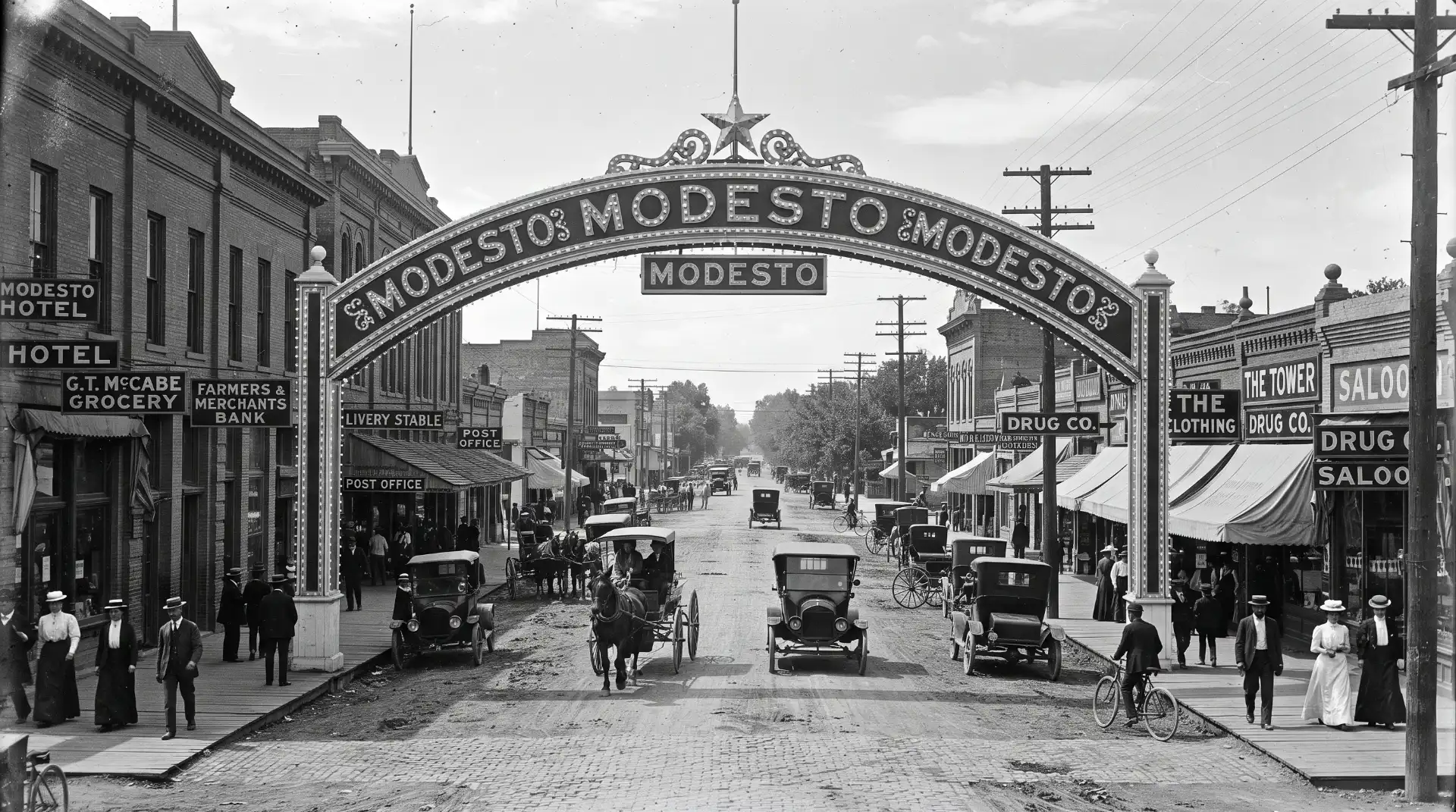
In 1911, the Modesto Business Men’s Association proposed constructing an “Ornamental and Electric Arch” at Ninth and I Streets. The proposed structure was intended to be much more than a simple sign. It was designed as a prominent civic feature that could welcome people entering downtown while promoting Modesto as a successful and growing community.
The idea reflected a broader trend in American cities during the late nineteenth and early twentieth centuries. Communities frequently used public architecture, monuments, signs, slogans, festivals, and other civic improvements to promote their economic potential. This period is sometimes associated with civic “boosterism,” in which local business leaders actively promoted their communities in the hope of attracting investment, residents, businesses, and visitors.
The Modesto Arch fit perfectly into this environment. Its position across a downtown street gave it high visibility, while its electric lighting allowed it to remain impressive after sunset. The structure communicated the name of the city in a very direct way, while its slogan presented an optimistic message about the community.
The arch was also part of a larger period of civic development in Modesto. During the same general era, the community was investing in public buildings, parks, transportation infrastructure, and other improvements. The arch was one visible expression of a city that was becoming increasingly confident about its future.
The Famous Modesto Slogan
One of the most interesting stories connected to the Modesto Arch is the history of its famous slogan. Local leaders wanted a phrase that could represent the city, and a contest was held for a city slogan and seal. The winning slogan was submitted by James Hanscom and read, “Nobody’s Got Modesto’s Goat.”
Although that phrase won first place, it was not ultimately used on the arch. Sol P. Elias, who later became mayor, and members of the Modesto Business Men’s Association objected to the winning entry. Instead, they supported a runner-up slogan submitted by S. R. Harbaugh.
That slogan was “Water Wealth Contentment Health.”
The phrase became one of the most recognizable elements of the Modesto Arch and has remained associated with the city for generations. While the original winning slogan has become an entertaining footnote in local history, the replacement slogan tells us considerably more about what local leaders wanted Modesto to represent.
The word “water” was especially meaningful for a Central Valley agricultural community. Water was fundamental to farming and economic development, while “wealth” reflected the prosperity that local leaders hoped agriculture and commerce would create. “Contentment” and “health” conveyed an ideal of community well-being. Together, the four words presented a positive vision of Modesto at a time when the city was still establishing its identity.
The story of the slogan also demonstrates that local identity is not always something that develops naturally. Communities sometimes deliberately create symbols and messages that they believe represent their values and ambitions. In Modesto, the arch became the physical structure that carried that message into the future.
Who Designed the Modesto Arch?
The Modesto Arch was designed by Bernard Joseph, a Modesto architect. His design reflected the period’s interest in combining practical engineering with decorative civic architecture. The structure was intended to be attractive during the day and especially impressive at night when its electric lights were illuminated.
The project was funded through public subscription, meaning that members of the community contributed toward the cost. This detail is significant because it demonstrates the level of local participation associated with the project. The arch was not simply something imposed on the community without connection to local interests. Business leaders and residents were investing in a structure intended to represent their city.
Architecturally, the Modesto Arch combines a steel-truss span with substantial decorative support piers. The structure is approximately 25 feet high and 75 feet wide, and historical documentation records 668 lights. Its large lettering and decorative architectural elements were designed to make the structure highly visible from the surrounding streets.
The arch was therefore both an engineering project and a piece of civic architecture. It had to span a street while also serving as a visual statement about the city. That combination helped distinguish it from an ordinary commercial sign.
The Dedication of the Modesto Arch
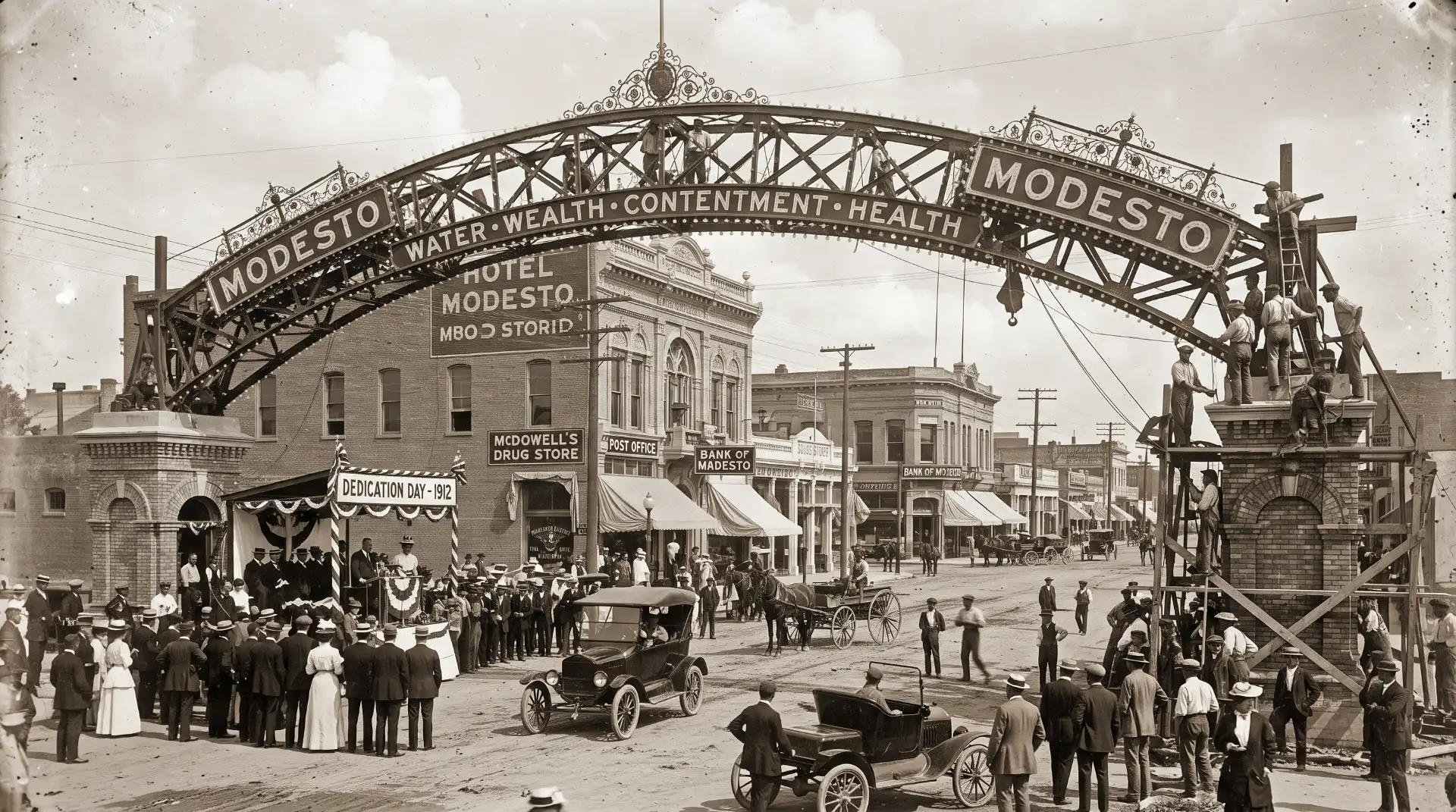
The Modesto Arch was dedicated on March 9, 1912. Its completion came during an important period in the development of the city, when Modesto was becoming an increasingly established agricultural and commercial center.
The early twentieth century was a period of major technological and social change in California. Electricity was expanding, automobiles were beginning to appear on city streets, railroads remained essential to transportation, and agriculture was becoming increasingly commercialized. The arch brought several of these developments together in one structure.
Its electric lights were particularly important. Today, illuminated signs are so common that they can seem unremarkable, but electric lighting represented modern technology during the early 1900s. An illuminated civic structure could make a strong impression after dark and communicate the idea that Modesto was a modern community connected to the technological changes taking place across the United States.
The arch’s location also mattered. It stood at a prominent downtown intersection, where people could see the city’s name as they moved through the community. It functioned as a gateway while also serving as a public symbol.
Modesto and the Early Automobile Age
One of the most fascinating details in the history of the Modesto Arch is how few automobiles were in the community when it was constructed. Historical documentation indicates that there were approximately 85 automobiles in Modesto when the arch was built.
That number helps explain why the structure was originally designed without the traffic concerns that would later become important. In 1912, horse-drawn vehicles, pedestrians, bicycles, trains, and a relatively small number of automobiles shared the transportation landscape.
Within a few decades, the situation had changed dramatically. Automobile ownership increased throughout California, and streets that had once accommodated relatively modest traffic volumes became increasingly busy.
The Modesto Arch was built before the automobile completely transformed American cities. Its history therefore provides a useful example of how quickly transportation patterns could change during the twentieth century.
The landmark that had been designed to welcome people into downtown eventually had to be adjusted because the way people traveled through downtown had changed.
Why the Modesto Arch Was Moved
By the 1930s, automobile traffic had increased enough to create visibility problems at Ninth and I Streets. The location of the arch became a concern for motorists, particularly when making turns at the intersection.
Instead of removing the landmark, the city moved it.
The Modesto Arch was relocated approximately 37 feet to the west as part of changes associated with Ninth Street. This decision is an important part of the structure’s preservation story because it demonstrates that historic preservation does not always mean leaving a structure completely untouched.
Cities change. Streets are widened. Traffic patterns evolve. New transportation systems develop. Historic structures sometimes have to be adapted if they are going to survive.
In the case of the Modesto Arch, relocation allowed the structure to remain part of downtown while accommodating the changing needs of the city.
The move also illustrates why historic preservation can be complicated. Communities must often balance practical needs with the desire to retain historic resources. The survival of the Modesto Arch demonstrates that those interests can sometimes coexist.
The Modesto Arch During World War II
The arch faced another major challenge during World War II. Steel was an important resource during the conflict, and communities throughout the United States participated in scrap drives to support the war effort.
Because the Modesto Arch was constructed largely from steel, it became a potential source of scrap material. The landmark could have been dismantled and used for another purpose.
However, local residents helped protect it.
According to City of Modesto historical information, local women played an important role in efforts to save the structure from being removed for its metal. The story demonstrates how much the meaning of the arch had changed since 1912.
When the arch was first built, its primary purpose was civic promotion. By the 1940s, residents increasingly viewed it as part of Modesto’s identity and history.
That distinction is important.
A structure can begin its life with one purpose and acquire another meaning over time. The Modesto Arch was created to promote a young and growing city, but later generations recognized that the structure itself had become part of the city’s heritage.
From Civic Advertisement to Historic Landmark
After World War II, Modesto continued to grow. New residential areas expanded beyond the traditional downtown core, automobile travel became increasingly important, and the appearance of the city continued to change.
As the city modernized, the original promotional purpose of the Modesto Arch became less important. Modesto no longer needed a 1912 civic advertisement to announce that it was a growing community.
Instead, the arch became valuable because it represented an earlier period.
This transition is one of the most interesting aspects of its history. The arch was originally designed to tell people what Modesto hoped to become. Today, it helps tell people what Modesto once was.
That is one of the defining characteristics of historic landmarks. Their significance can change as communities change around them.
A building that was once an ordinary business can later become an example of historic architecture. A school that once served hundreds of children can later become a reminder of earlier generations. A city gateway can become a symbol of civic identity.
The Modesto Arch followed that same path.
The Modesto Arch Receives Landmark Recognition
Modesto’s interest in historic preservation became more formal during the late twentieth century. The City established its Landmark Preservation Commission in 1987 to advise on historic sites and preservation matters.
The Modesto Arch subsequently received official local landmark recognition. The Landmark Preservation Commission adopted its designation resolution on August 21, 1989, and the City Council formally designated the arch on December 5, 1989.
The designation recognized the historical and architectural significance of the structure.
By this point, the arch had already survived more than seven decades of changes. It had survived the growth of automobile traffic, relocation, wartime pressures, and the changing appearance of downtown.
Formal landmark designation gave the structure another level of recognition and demonstrated that Modesto considered its preservation important.
The story fits into the larger history of historic preservation in Stanislaus County. Across the region, historic buildings and sites provide physical evidence of earlier generations and help residents understand how local communities developed.
You can explore more examples in our article, Forgotten Places of Stanislaus County: Historic Sites Worth Remembering.
The Modesto Arch and Stanislaus County History
Although the Modesto Arch is located within the city of Modesto, its story cannot be separated from the broader history of Stanislaus County.
The county developed through a combination of agriculture, transportation, water infrastructure, commerce, immigration, education, and community development. Modesto became an important center within that larger landscape.
The arch’s slogan makes the connection particularly clear. “Water Wealth Contentment Health” reflects the importance of resources and prosperity during a period when agriculture was transforming the Central Valley.
Water was essential to farming. Farming supported businesses. Businesses supported employment. Transportation connected farms and communities with markets. Population growth created demand for schools, public buildings, services, and infrastructure.
The arch therefore represents much more than downtown Modesto.
It represents a period when the broader Central Valley was becoming economically and socially interconnected.
For readers interested in the deeper history of the county’s name and Indigenous history, our article Who Was Estanislao? The Indigenous Leader Behind Stanislaus County’s Name provides another perspective on the region’s much earlier history.
The Architecture of the Modesto Arch
The physical design of the Modesto Arch helps explain why it has remained visually recognizable for so long. The structure combines a large steel-truss span with decorative support piers and prominent lettering.
The City of Modesto’s historic documentation describes the arch as approximately 25 feet high and 75 feet wide. It includes 668 lights, which were an important feature of its original design. The support elements contain decorative details influenced by classical architectural forms, including Doric columns and other ornamental features.
The combination of engineering and decoration was intentional. The structure needed to span a roadway, but it also needed to look impressive.
The large “MODESTO” lettering ensured that the city’s name was immediately visible. The slogan beneath it reinforced the civic message.
This combination makes the arch different from many historic structures. It is simultaneously infrastructure, architecture, signage, and public art.
That unusual combination has helped it remain one of Modesto’s most recognizable landmarks.
Why the Arch Still Stands Out Today
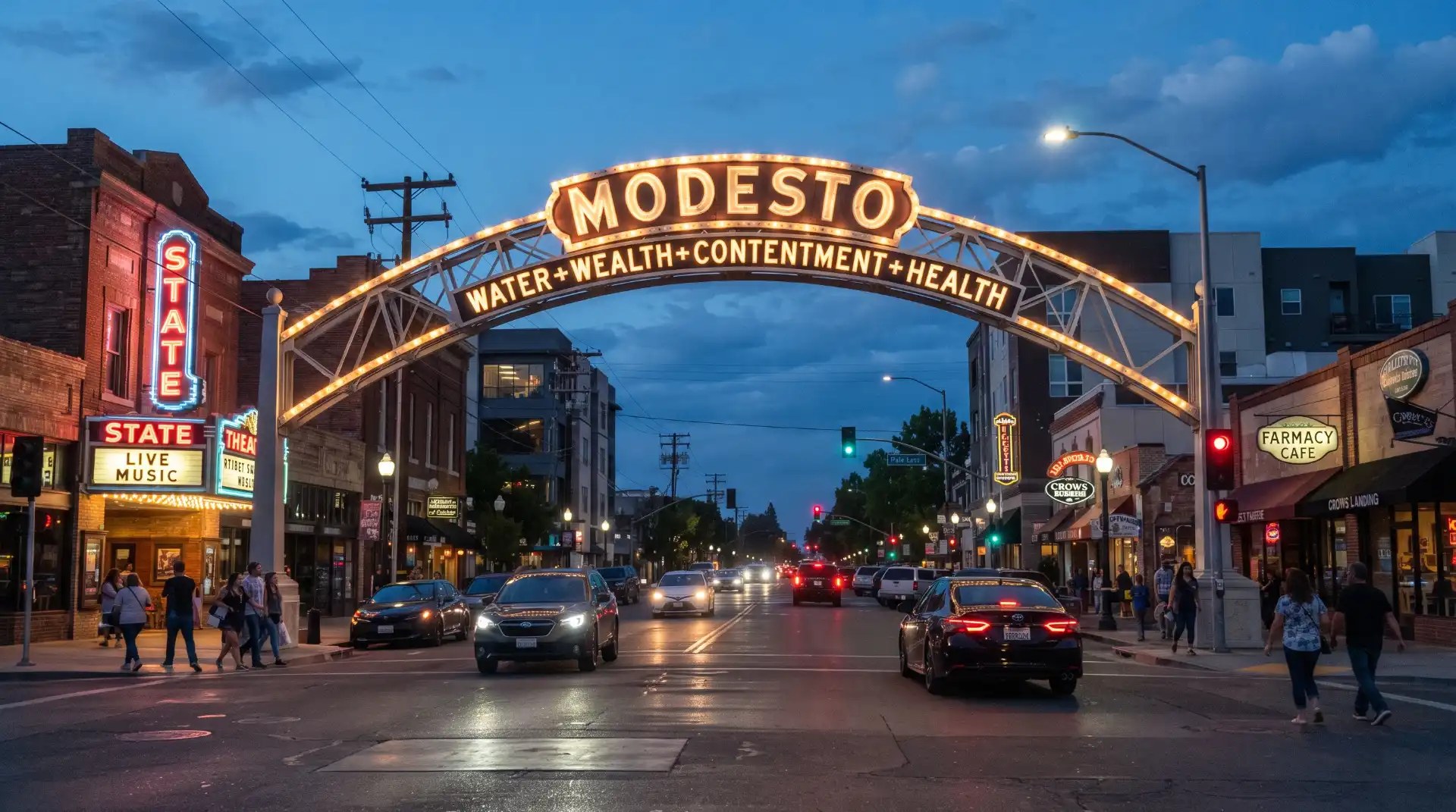
Modern Modesto is very different from the city of 1912. Cars now dominate the streets, buildings have changed, technology has transformed daily life, and the city has expanded significantly beyond its early downtown boundaries.
Yet the Modesto Arch remains recognizable.
Part of its appeal comes from contrast. Modern vehicles pass underneath a structure that was built when automobiles were still relatively uncommon. Modern buildings surround a landmark that was created during the early years of the twentieth century. Contemporary residents see the same basic structure that earlier generations saw when downtown Modesto was much smaller.
That contrast gives the arch its historical power.
It allows people to see the past without having to visit a separate museum.
History is physically integrated into the modern city.
For people who live in Modesto, that can provide a sense of continuity. For visitors, it provides an immediate introduction to the city’s history.
The Modesto Arch as a Symbol of Local Identity
A landmark becomes a symbol when a community repeatedly associates it with a particular place.
The Modesto Arch has achieved that status over more than a century.
Its name is literally displayed above the street. Its shape is distinctive. Its slogan is unique. Its history is closely tied to the city’s development.
As a result, the arch has become useful not only as a historic structure but also as a visual representation of Modesto.
Photographs of the arch can immediately communicate a location. Historical documents can use it to represent downtown Modesto. Community organizations can use its image when discussing local heritage.
This is an important difference between a historic object and a community symbol.
The arch is valuable because it is old, but its significance goes beyond age.
It represents the people, ambitions, changes, and memories associated with Modesto over generations.
What the Modesto Arch Can Teach Us
The Modesto Arch provides a surprisingly broad lesson in local history.
It can teach us about the growth of railroad towns and the development of the Central Valley. It can teach us about agricultural economics and the importance of water. It can teach us about the arrival of electricity and the early automobile age.
It can also teach us about civic boosterism and how communities deliberately created public symbols to promote themselves.
Its relocation demonstrates how transportation changes can affect historic structures. Its survival during World War II demonstrates the role that community members can play in preserving historic resources.
Its landmark designation demonstrates how attitudes toward historic preservation can change over time.
Most importantly, the arch demonstrates that local history is interconnected.
A single structure can lead to questions about transportation, agriculture, architecture, economics, politics, technology, preservation, and community identity.
That is what makes local history so valuable.
The Modesto Arch and the City’s Agricultural Story
The word “water” in the arch’s famous slogan is especially meaningful when viewed through the history of Stanislaus County agriculture.
The Central Valley’s agricultural economy has depended on the ability to manage and distribute water. Irrigation transformed the possibilities for farming and contributed to the economic development of communities throughout the region.
Modesto’s growth cannot be separated from this agricultural environment.
Farmers needed transportation.
Businesses supplied agricultural communities.
Workers moved into the region.
Railroads moved products.
Downtown businesses served surrounding communities.
As these activities expanded, Modesto developed into a regional center.
The arch’s slogan therefore captures something fundamental about the community that built it. The words may appear simple, but they reflect the economic hopes of an agricultural city.
For readers interested in this side of the story, the McHenry Museum & Historical Society is an excellent local resource. Its exhibits cover subjects including agriculture, irrigation, railroads, schools, and other aspects of Stanislaus County history.
The Arch and the History of Downtown Modesto
The location of the Modesto Arch is also important because downtown itself has changed considerably.
When the structure was built, downtown Modesto was the center of commercial activity. The streets were shaped by the city’s railroad origins, and businesses served residents and travelers moving through the growing community.
The arrival of more automobiles gradually changed how downtown functioned.
Roads became busier.
Parking became more important.
Traffic patterns changed.
Businesses adapted.
New forms of transportation influenced urban development.
Through all these changes, the arch remained a recognizable feature.
That makes it a useful reference point when thinking about how downtown Modesto has evolved.
A person standing near the arch today can look around and see a modern city while also recognizing the street layout and landmark that connect the location to the early twentieth century.
The Importance of Preserving Local Landmarks
The survival of the Modesto Arch illustrates why local historic preservation matters.
National history is often taught through major wars, presidents, inventions, and large political events. Those subjects are important, but they do not always explain how ordinary communities developed.
Local landmarks provide another perspective.
They show where people lived, worked, traveled, worshiped, studied, and conducted business.
They provide physical evidence of changes that might otherwise be difficult to visualize.
The Modesto Arch is particularly useful because it has survived through so many different periods of the city’s development.
It has seen horse-drawn transportation give way to automobiles. It has survived wartime pressures and downtown changes. It has remained recognizable while the city around it has expanded.
Preserving the arch therefore preserves a physical connection between generations of Modesto residents.
Exploring the Modesto Arch Through Family History
Historic landmarks can also be useful when researching family history.
A family whose relatives lived in Modesto during the early twentieth century may have connections to the downtown area, local businesses, schools, farms, or transportation networks.
The arch provides a fixed point around which those stories can be organized.
Old photographs may show family members standing near downtown buildings. Newspaper advertisements may mention businesses located close to Ninth and I Streets. City directories and historical records can reveal where residents lived and worked.
Local landmarks can therefore help transform genealogy from a list of names and dates into a story connected to a real place.
The Modesto Arch is one of those places.
The Modesto Arch as an Educational Landmark
For teachers, parents, students, and local historians, the arch can serve as a starting point for educational projects.
Students can investigate why the arch was built and compare Modesto in 1912 with the city today. They can research the history of automobiles and examine how transportation influenced the arch’s relocation. They can study the slogan contest and consider what it tells us about civic identity.
They can also investigate the history of irrigation and agriculture in Stanislaus County and ask why water was important enough to appear in the city’s most famous slogan.
A classroom project could even compare historic photographs of the arch with modern photographs taken from the same location.
Such comparisons allow students to see how streets, buildings, vehicles, clothing, technology, and community life changed over time.
The landmark becomes more than an object.
It becomes a primary source.
A Timeline of the Modesto Arch
The history of the Modesto Arch can be understood through several important milestones. In 1911, the Modesto Business Men’s Association proposed an ornamental and electric arch for Ninth and I Streets. Around the same time, a contest was held for a city slogan and seal. James Hanscom’s “Nobody’s Got Modesto’s Goat” won first place, but local leaders ultimately selected S. R. Harbaugh’s “Water Wealth Contentment Health” for the arch.
The structure was designed by Modesto architect Bernard Joseph and funded through public subscription. The Modesto Arch was dedicated on March 9, 1912. At the time, the community had only about 85 automobiles, illustrating how different the transportation environment was from the one that exists today.
During the 1930s, increased automobile traffic created visibility problems at Ninth and I Streets. The arch was subsequently moved approximately 37 feet to accommodate changes to the street. During World War II, the structure faced another threat when its steel became potentially valuable for scrap. Local efforts helped save the landmark.
In the late twentieth century, preservation efforts became more formal. Modesto established its Landmark Preservation Commission in 1987. The Modesto Arch received official local landmark designation in 1989, further recognizing its importance to the city’s history and architectural heritage.
The Modesto Arch Today
More than a century after its dedication, the Modesto Arch continues to occupy its place in downtown Modesto.
Its surroundings have changed dramatically, but the landmark remains recognizable. The lights, lettering, steel structure, and slogan continue to connect the modern city with its early twentieth-century past.
For visitors, the arch offers an easy introduction to Modesto history. For residents, it can serve as a reminder that the city they know today has developed through many generations of change.
The landmark is also part of a larger collection of historic resources throughout the city and county. The McHenry Museum & Historical Society identifies the Modesto Arch among historically significant sites in Stanislaus County, while the City of Modesto maintains historical information about the structure and other local landmarks.
Together, these resources help preserve the stories behind the places that define the region.
Why the Modesto Arch Still Matters
The history of the Modesto Arch is ultimately a story about how a community changes while maintaining connections to its past.
The arch was built in 1912 to promote a young and growing city. Its electric lights represented modern technology. Its slogan expressed optimism about water, prosperity, community well-being, and health. Its location provided a prominent gateway into downtown.
But the city continued to evolve.
Automobiles became common. Roads changed. The arch was moved. World War II created a threat to its survival. Later generations began viewing it as a historic resource rather than simply a promotional structure.
That transformation is what makes the Modesto Arch so important.
It represents more than the year in which it was built.
It represents the generations that followed.
It tells the story of a railroad community becoming an agricultural center, an agricultural center becoming a larger city, and a promotional structure becoming a historic landmark.
It also demonstrates why local history deserves attention.
History is not always found in distant places or famous national monuments. Sometimes it is directly above a downtown street. Sometimes it is a familiar structure that people pass every day without realizing how much history is attached to it.
The Modesto Arch is one of those places.
Conclusion
The Modesto Arch has stood over downtown Modesto for more than a century, witnessing the transformation of the city around it. Built in 1912 during a period of civic optimism and economic growth, the structure was designed to promote Modesto and welcome people into the community.
Its famous “Water Wealth Contentment Health” slogan reflected the priorities of a Central Valley city whose prosperity was closely connected to agriculture, water, transportation, and commerce. Its electric lights represented modern technology, while its large steel structure and decorative details gave the city a distinctive gateway.
Over the decades, the arch became more than the promotional structure its creators originally intended. It survived increasing automobile traffic, was relocated to accommodate changes to downtown streets, and faced the possibility of being dismantled for scrap during World War II. Local residents helped preserve it, and later generations formally recognized its historical importance.
Today, the Modesto Arch is one of the clearest visual symbols of the city. It connects the modern streets of downtown Modesto with the community that existed more than 100 years ago. It reminds residents and visitors that the city has a long history shaped by railroads, agriculture, water, commerce, technology, transportation, and civic ambition.
The next time you see the Modesto Arch, it is worth looking beyond the lights and lettering. Think about the Modesto of 1912, when automobiles were still rare and the Central Valley was undergoing major agricultural and economic changes. Think about the people who built the structure, the residents who helped save it, and the generations that have passed beneath it.
The arch is not simply a landmark.
It is a surviving piece of Modesto’s story.
And that is why the history of the Modesto Arch remains an important part of understanding Stanislaus County and the Central Valley.