
Stanislaus County is widely recognized today as one of California’s most important agricultural regions, but the modern dairy industry did not appear overnight. Its roots reach back more than a century, to a period when irrigation was transforming the Central Valley, family farms were spreading across newly productive land, and immigrant farmers were bringing agricultural traditions from Europe to California.
Dairy farming became particularly important because several developments came together at the right time. Reliable irrigation created better conditions for growing alfalfa, one of the most valuable feeds for dairy cattle. Smaller farms gave families opportunities to establish agricultural businesses. Railroads and improved roads made it easier to move agricultural products to growing markets. Refrigeration, pasteurization, improved animal nutrition, and changing dairy technology then allowed local farmers to produce and market milk on a much larger scale.
The result was a remarkable transformation. What began with relatively small family dairies eventually developed into one of the most economically important agricultural industries in Stanislaus County.
The story of dairy farming is therefore more than the story of cows and milk. It is also a story about irrigation, immigration, family businesses, technology, transportation, changing rural communities, and the relationship between Stanislaus County’s agricultural past and its present.
Today, milk remains one of the county’s leading agricultural commodities. According to the 2025 Stanislaus County Agricultural Report, milk generated approximately $676.3 million in gross agricultural value, making it the county’s second-highest-value commodity behind almonds.
Understanding how that industry developed helps explain why dairy farms became such a defining part of the Central Valley landscape.
Before Dairy Became an Agricultural Powerhouse
When American settlement expanded across California’s Central Valley during the nineteenth century, Stanislaus County was already a productive agricultural region. However, farming looked very different from the highly specialized agriculture residents see today.
Early farmers grew grains and raised livestock, while transportation and water availability placed limits on what could be produced profitably. Wheat became particularly important during the nineteenth century, supported by the development of transportation networks that allowed agricultural products to reach distant markets.
Dairy existed during this period, but it was not yet the dominant agricultural industry that it would eventually become.
Historical records show that by the late nineteenth century, Stanislaus County farmers were producing dairy products along with wheat, potatoes, beans, barley, oats, fruits, and other crops. Dairy was part of the agricultural economy, but the county had not yet developed the specialized infrastructure necessary for large-scale milk production.
The major change came with water.
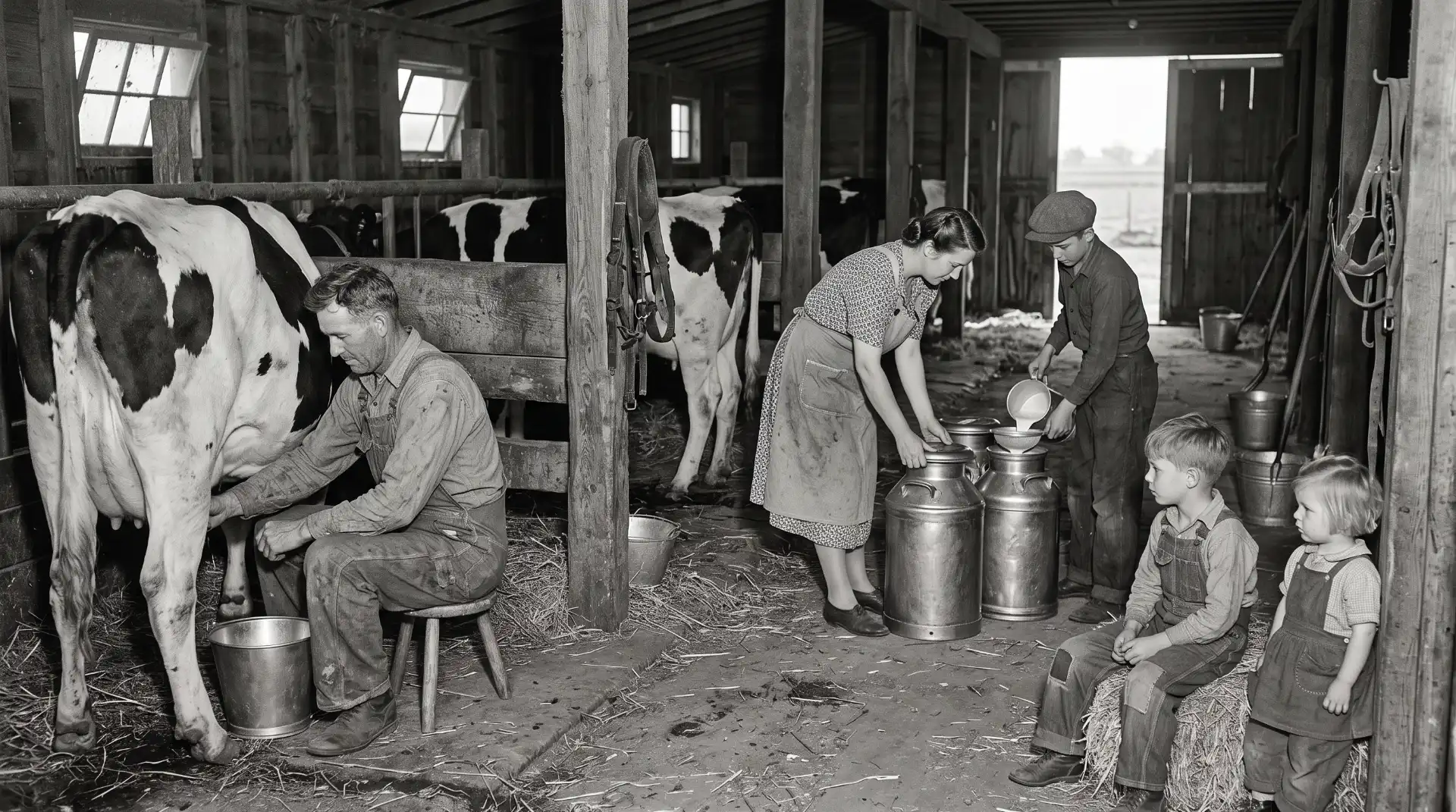
Irrigation Changed Stanislaus County Agriculture
The development of irrigation districts around the beginning of the twentieth century fundamentally changed Stanislaus County.
Reliable water made it possible for farmers to cultivate crops that required more dependable moisture than the naturally dry Central Valley could provide. One of the most important of these crops was alfalfa.
Alfalfa became an ideal feed crop for dairy cattle. Instead of depending primarily on open grazing, farmers could grow large quantities of nutritious feed close to their barns. This allowed cattle to be kept in more controlled environments and made dairy production increasingly practical.
The history of the Modesto Irrigation District demonstrates how closely irrigation and dairying became connected. The district’s historical account explains that after irrigation water became available, alfalfa quickly became a dominant crop and dairying became a major part of the agricultural economy. By 1909, more than 16,000 of the district’s 22,000 irrigated acres were planted in alfalfa.
This was a critical turning point.
Farmers no longer had to think of livestock primarily as animals roaming over large areas of grazing land. They could produce feed, keep cattle closer to milking facilities, and develop farms around a more predictable production system.
Within only a few years, dairy farming had expanded dramatically.
The Modesto Irrigation District’s historical record notes that Stanislaus County’s dairy industry doubled during the first decade of the twentieth century and began surpassing wheat in importance.
Water had helped create the foundation.
Families would build the industry on top of it.
The Family Farm Became the Foundation of Dairy
One of the most important characteristics of Stanislaus County’s dairy history is the role of family-owned farms.
Early dairies were generally much smaller than the operations people might associate with modern California dairy production. Families could operate dairies with only a few dozen cows, often combining livestock with crop production.
The work was intensive.
Milking had to be done regularly. Cattle needed to be fed and cared for every day. Fields had to be irrigated and harvested. Milk had to be handled properly and transported to a creamery or other market.
There was little separation between family life and farm life.
Children might grow up feeding calves, cleaning equipment, helping with chores, or learning how to manage crops. Parents and grandparents passed agricultural knowledge from one generation to the next. The farm was simultaneously a workplace, a home, an investment, and a family legacy.
The 2024 Stanislaus County Agricultural Report describes this early period as one in which small family dairies with only a few dozen milking cows supplied nearby communities. It also notes that many local dairy operations still carry Portuguese, Swiss, and Dutch family names, reflecting the importance of immigrant agricultural traditions in the county.
Those family names are an important part of the story.
Dairy farming did not develop in Stanislaus County simply because the land was productive. People brought knowledge, traditions, business practices, and agricultural skills with them.
Immigrant Farmers and the Growth of Dairy Culture
Immigration played an important role in California dairying.
Farmers from Europe and other parts of the world arrived with experience raising cattle and producing milk, butter, cheese, and other dairy products. In Stanislaus County, Portuguese, Swiss, Dutch, and other immigrant communities contributed to the development of dairy agriculture.
These farmers adapted their existing knowledge to the Central Valley environment.
California’s climate was different from the environments many immigrants had left behind, but irrigation made it possible to produce reliable feed crops. The combination of European dairy traditions and Central Valley agricultural resources proved highly successful.
The result was not simply an increase in the number of cows.
It was the development of a dairy culture.
Families established farms, purchased additional acreage, built barns, improved breeding programs, developed relationships with creameries, and participated in agricultural organizations. Over time, dairy farming became part of the identity of communities throughout the county.
Some family operations remained relatively small, while others gradually expanded.
This pattern would continue for generations.
The Dairy Industry and the Growth of Modesto
The rise of dairy farming also influenced the growth of Modesto and surrounding communities.
Agriculture created demand for transportation, equipment, feed, banking, veterinary services, construction, processing, and other businesses. Dairy farmers needed supplies, while creameries and processors needed reliable sources of milk.
The development of irrigation also encouraged population growth.
The Modesto Irrigation District’s historical account describes how large ranches were divided into smaller family farms after irrigation water became available. The number of assessment payers grew dramatically during the first decades of the district, while the number of farms increased as agricultural settlement expanded.
This transformation helped create the rural community structure that became characteristic of Stanislaus County.
Small farms were located around developing towns. Roads connected agricultural areas with markets. Railroads provided important transportation links. Schools and community institutions developed as families settled in rural areas.
The history of local education provides another window into this transformation. Your article on Stanislaus County’s Historic Schools: The Stories Behind Their Names explores how rural schools became important community institutions as agricultural populations grew.
Dairy farming was part of this larger process of community development.
From Hand Milking to Organized Dairy Production
Early dairy farming required enormous amounts of manual labor.
Milking was commonly done by hand, sometimes multiple times a day. Milk was collected in cans and moved to local processing facilities. Farmers had to keep equipment clean and maintain the health of their animals without many of the technologies available today.
A dairy with several dozen cows could require the labor of an entire family.
The economics of dairy farming were also challenging. Milk production had to continue regardless of weather, market conditions, or personal circumstances. Cows needed care every day.
Historical oral histories from the Stanislaus region provide glimpses into these realities. One family account from the Stanislaus Regional Oral History Project describes dairy farming as a demanding family business in which changing milk prices and economic conditions could determine whether a family continued operating a dairy.
These personal stories are valuable because statistics cannot fully explain what dairy farming meant to families.
A production report can tell us how much milk was produced.
An oral history can tell us what it felt like to live with the work.
Both are important to understanding local history.
The 1920s and 1930s: Dairy Becomes a Major Industry
By the 1920s and 1930s, dairy farming had moved far beyond its earlier role as a relatively minor agricultural activity.
Historical research prepared for Stanislaus County transportation and infrastructure planning notes that dairy farms increased during the 1920s and 1930s as livestock production shifted away from open-range beef cattle toward smaller, more enclosed dairy operations. These farms produced milk as well as cheese, cream, and butter. By 1935, Stanislaus County ranked second in the country for dairy production according to the historical sources cited in the report.
This was an extraordinary transformation.
Within only a few decades, a county that had been strongly associated with grain farming had become one of America’s major dairy-producing regions.
Several factors contributed to this growth.
Irrigation provided feed crops. Families supplied labor and management. Improved transportation connected farms to markets. Processing facilities created outlets for milk. New technologies improved food safety and extended the usable life of dairy products.
The industry was becoming increasingly interconnected.
Pasteurization, Refrigeration, and Transportation
Technology changed dairy farming just as significantly as irrigation had.
Milk is highly perishable. Before modern refrigeration and processing, farmers had limited opportunities to transport fresh milk long distances.
Pasteurization helped improve safety by reducing harmful microorganisms in milk. Refrigeration allowed milk to remain usable for longer periods. Better roads and transportation systems made it possible to move agricultural products more efficiently.
These innovations allowed dairy production to become less dependent on immediate local consumption.
California’s geography also influenced the industry. The state’s major population centers provided large markets for milk and dairy products, while agricultural regions such as Stanislaus County could specialize in production.
The California Department of Food and Agriculture traces the state’s dairy regulation history back to the nineteenth century, including early laws addressing dairy products, sanitation, milk inspection, and pasteurization.
For historians, these changes demonstrate that dairy farming was never simply about raising cows.
It depended on an entire system of agriculture, science, regulation, transportation, processing, and commerce.
The Rise of Dairy Cooperatives
As dairy farming expanded, farmers also recognized the advantages of working together.
Individual family farms often had limited bargaining power when selling milk. Cooperatives gave producers a way to pool milk, organize marketing, improve processing, and create stronger relationships with buyers.
The development of dairy cooperatives became an important part of California’s agricultural history.
The 2024 Stanislaus County Agricultural Report notes that the local Milk Producers Association grew into one of the nation’s largest dairy cooperatives.
This cooperative tradition reflects an important principle of agricultural history.
Family ownership did not necessarily mean farmers worked entirely alone.
They could own their individual farms while participating in organizations that allowed them to compete in larger markets.
That balance between family ownership and large-scale agricultural infrastructure remains an important characteristic of California dairy production.
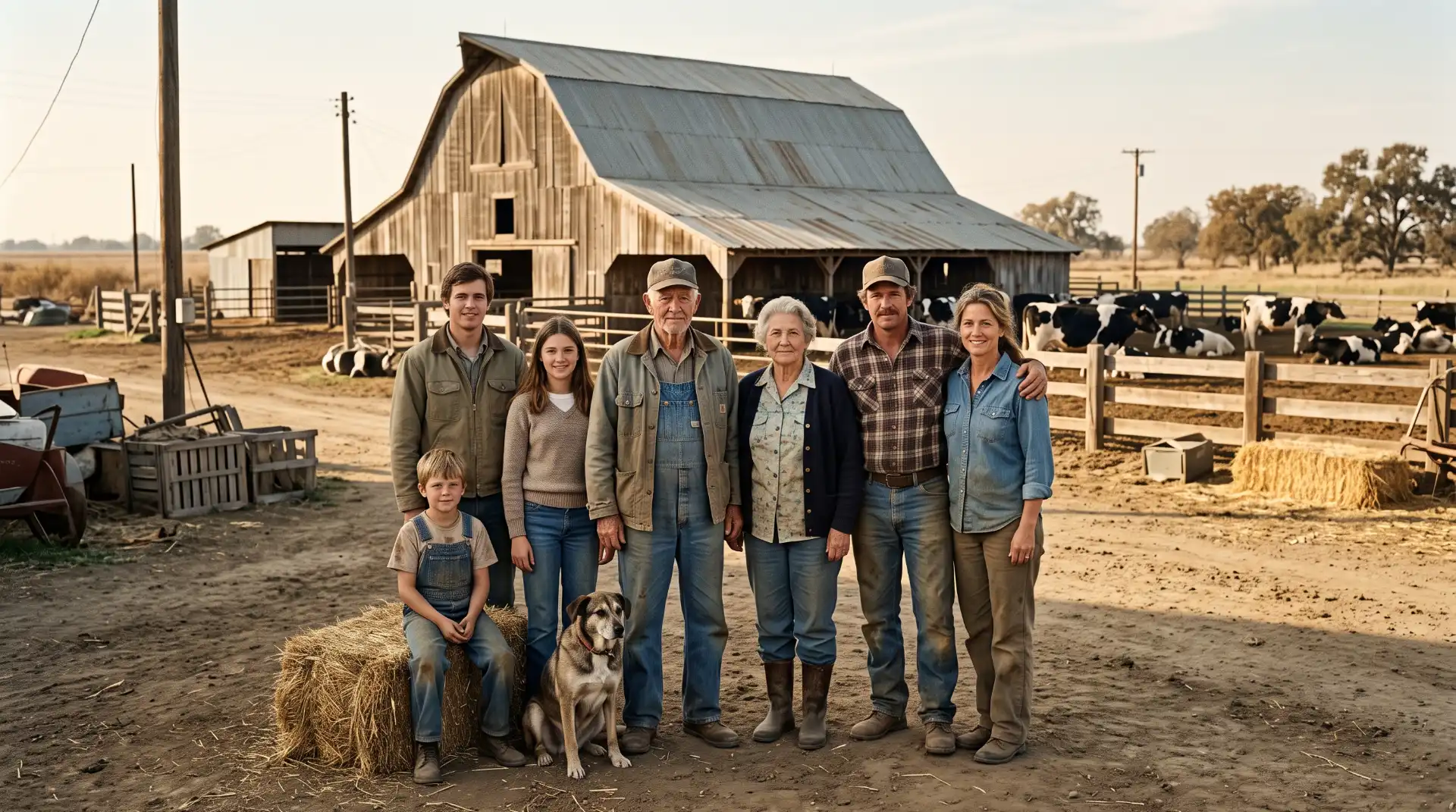
Generations of Dairy Families
Some of the best stories in Stanislaus County dairy history are family stories.
Consider the history of Lucas Dairy, which was founded by Tony Lucas in 1938. According to the Stanislaus County Agricultural Report, Norman Lucas worked alongside his father before developing the family business with his wife, Freda. Their operation eventually grew to hundreds of acres and hundreds of Holstein cows, while later generations of the family remained involved in agriculture.
Another example is Fiscalini Farms.
The Fiscalini dairy was founded in 1914 by John B. Fiscalini with 12 Holstein cows and grazing land. Over subsequent generations, the operation expanded significantly and eventually incorporated cheese production and a methane digester.
These examples illustrate a broader pattern.
Expansion did not necessarily mean abandoning the family farm.
Instead, families often adapted their businesses to changing economic conditions and technology.
A farm could remain family-owned while becoming considerably larger and more sophisticated.
Dairy Farms and the Rural Landscape
For much of the twentieth century, dairy farms helped define the visual character of rural Stanislaus County.
Barns, corrals, feed storage areas, irrigation canals, alfalfa fields, silos, milk trucks, and cattle were familiar parts of the landscape.
The rural landscape also reflected the relationship between crops and livestock.
Alfalfa and other feed crops supported cattle. Manure returned nutrients to agricultural land. Water infrastructure supported feed production. Roads connected farms with processing facilities and communities.
This created an agricultural system in which different parts of the farm economy supported one another.
Today, much of the county has changed.
Residential development has expanded. Roads have become busier. Some historic farms have disappeared, moved, or been surrounded by urban growth.
That makes agricultural preservation increasingly important to local history.
Your site’s article Forgotten Places of Stanislaus County: Historic Sites Worth Remembering provides a natural starting point for thinking about how agricultural places fit into the broader history of the county.
A dairy barn may look like an ordinary agricultural structure, but it can represent decades of family history.
Why Holstein Cows Became So Important
The black-and-white Holstein has become one of the most recognizable symbols of American dairy farming.
Holsteins became particularly important in California because of their ability to produce large quantities of milk under managed conditions.
Modern dairy production has dramatically increased the amount of milk produced per cow compared with earlier generations.
The 2024 Stanislaus County Agricultural Report notes that modern Holsteins can produce more than 10 gallons of milk per day, reflecting improvements in nutrition, genetics, management, and animal care.
This illustrates one of the biggest changes between historic and modern dairy farming.
Early dairy farmers improved their herds through selective breeding and careful management, but they had access to far fewer scientific tools.
Today’s producers can use sophisticated genetic information, specialized nutrition programs, reproductive technologies, veterinary care, and computerized monitoring systems.
The fundamental relationship between farmer and animal remains, but the tools have changed dramatically.
Technology Transformed the Modern Dairy
Modern Stanislaus County dairy farms can look very different from the small family dairies of the early twentieth century.
Today’s operations may use computerized feeding systems, specialized barns, ventilation systems, cooling equipment, automated milking technology, advanced reproductive techniques, and detailed animal-health monitoring.
The purpose of many of these technologies is straightforward: produce milk efficiently while improving animal care and making farm labor safer and more manageable.
Modern dairy barns are often designed around cow comfort.
Fans and misters help animals deal with Central Valley heat. Freestall systems provide cattle with areas to rest. Bedding systems are designed around cleanliness and comfort.
Technology also helps farmers monitor individual animals.
A cow’s production, health, reproductive status, and feeding needs can be tracked more precisely than ever before.
The result is an industry that would be almost unrecognizable to a dairy farmer from 1905.
Yet the basic goal remains remarkably similar: care for the animals, grow or obtain quality feed, produce milk, and maintain a sustainable family business.
Environmental Challenges and New Solutions
Modern dairy farming also faces questions that earlier generations did not encounter in the same way.
Water management, air quality, manure management, greenhouse-gas emissions, land use, and energy consumption have become important parts of agricultural policy and farm planning.
Stanislaus County dairy farmers have increasingly adopted technologies designed to address some of these challenges.
Manure can be collected and processed for agricultural uses or energy production. Anaerobic digesters can capture methane from manure and convert it into usable energy or renewable natural gas. Some operations also explore feed strategies intended to reduce methane emissions.
The 2024 county agricultural report specifically highlights manure methane capture, alternative feed strategies, and the diversion of certain food and municipal wastes into cattle feed as examples of changing dairy practices.
These developments show that the history of dairy farming is still being written.
The industry has always adapted to new circumstances.
In the early twentieth century, the major innovations were irrigation, refrigeration, pasteurization, transportation, and improved dairy organization.
Today, the focus includes automation, genetics, environmental technology, renewable energy, and precision agriculture.
Dairy Farming in Stanislaus County Today
Although the number of individual dairy operations is far smaller than the number of small family farms that once existed across the county, dairy remains economically significant.
The 2025 Stanislaus County Agricultural Report records milk as the county’s second-largest agricultural commodity, with a gross value of approximately $676.3 million. The report also shows that livestock and livestock products remain major components of the county’s overall agricultural economy.
This is important because it demonstrates the industry’s continuing influence.
Dairy is not merely a historical subject.
It remains part of the economic structure of modern Stanislaus County.
At the same time, today’s dairy industry is more concentrated and technologically sophisticated than the industry of a century ago.
The 2024 agricultural report identified approximately 132 dairies producing nearly 12 percent of California’s milk, placing Stanislaus County among the state’s leading dairy-producing counties.
That combination of fewer operations and greater production efficiency is one of the defining characteristics of modern agriculture.
Family Ownership in a Modern Industry
One of the most interesting aspects of Stanislaus County dairy farming is the continued importance of family ownership.
Large-scale production can sometimes create the impression that modern agriculture has become entirely corporate.
The historical record tells a more complicated story.
The 2024 Stanislaus County Agricultural Report notes that although modern California dairies are much larger than the small dairies of the past, nearly all remain family-owned.
This creates an important distinction between scale and ownership.
A family dairy may operate hundreds or even thousands of cows while still being managed and owned by multiple generations of the same family.
The equipment is larger.
The technology is more advanced.
The markets are broader.
But the family connection can remain.
That continuity is one of the most compelling themes in Stanislaus County’s agricultural history.
What Dairy Farming Tells Us About Stanislaus County
The history of dairy farming provides a useful way to understand the broader history of Stanislaus County.
It demonstrates how natural resources and human decisions interact.
The county had fertile soil, but irrigation made that soil more productive.
Farmers had agricultural knowledge, but new technologies allowed them to apply that knowledge more efficiently.
Families wanted economic opportunities, but transportation and markets made specialized agriculture possible.
Communities needed schools and businesses, while agricultural growth provided the population and economic activity that supported them.
In other words, dairy farming was never isolated from the rest of the county.
It was connected to almost every major development that shaped modern Stanislaus County.
The history of the county’s name provides another example of this layered past. Your article Who Was Estanislao? The Indigenous Leader Behind Stanislaus County’s Name examines the much older Indigenous history of the region and explains how the name Stanislaus became connected to the Central Valley landscape.
Dairy farming represents a much later chapter, but both histories demonstrate the same important principle: the modern county was built upon layers of earlier stories.
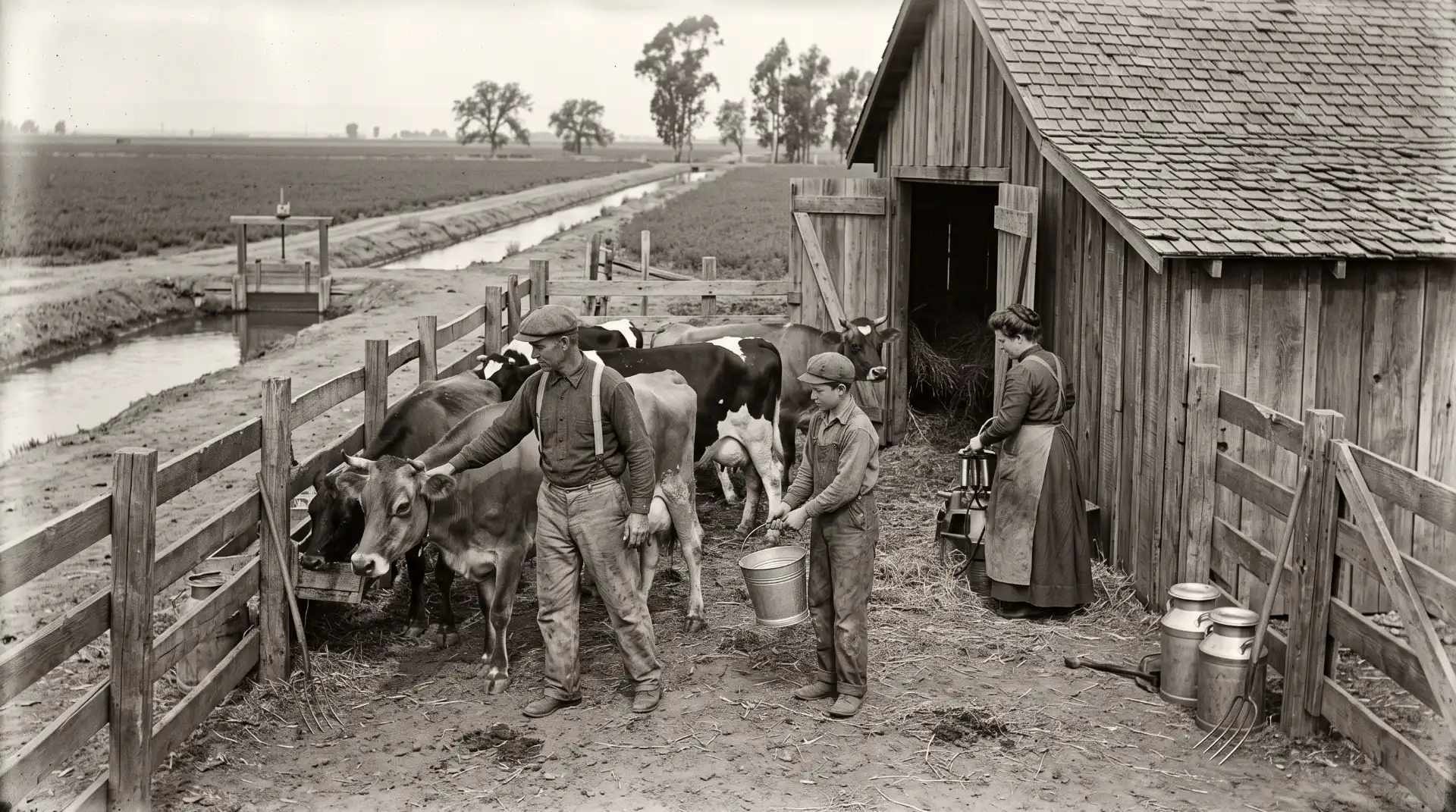
Preserving the Memory of Family Dairies
As Stanislaus County continues to develop, preserving agricultural history becomes increasingly important.
Historic photographs can show what dairy farms looked like.
Oral histories can preserve memories of milking cows before modern automation.
Family records can document land purchases, farm expansions, births, marriages, business changes, and difficult economic periods.
Old barns and agricultural structures can provide physical evidence of how farming once worked.
Even the names of farms can preserve the memory of families who spent generations working the land.
Local history organizations, libraries, museums, schools, universities, newspapers, agricultural agencies, and families all have a role to play in preserving these stories.
Agricultural history should not be limited to statistics.
A county report might tell us that milk was worth hundreds of millions of dollars.
A family photograph might show a child standing beside a calf.
An old diary might describe a difficult harvest.
A newspaper article might report the opening of a new creamery.
An oral history might explain why a family sold its cows and planted peaches instead.
Together, these sources create a much richer understanding of the past.
From Small Dairy Farms to a Major Agricultural Industry
The rise of dairy farming in Stanislaus County is ultimately a story of adaptation.
Farmers adapted to a dry climate by embracing irrigation.
They adapted their land to grow alfalfa and other feed crops.
Immigrant families adapted traditional European dairy practices to California conditions.
Small dairies adapted to changing markets.
Farmers adopted cooperatives, refrigeration, pasteurization, improved transportation, better breeding, and modern animal nutrition.
Later generations adopted computerized systems, advanced genetics, automated equipment, and environmental technologies.
The industry changed repeatedly without completely abandoning its family roots.
That is what makes Stanislaus County’s dairy history particularly significant.
A dairy farm that began with a few dozen cows could become a large modern operation over several generations.
A family that once milked cows by hand could eventually use sophisticated machinery and computer systems.
A county once dominated by wheat could become one of the most important dairy-producing regions in the United States.
The transformation was gradual, but the results were enormous.
Conclusion: A Legacy Still Shaping Stanislaus County
Dairy farming helped transform Stanislaus County from a primarily grain-producing agricultural region into one of the nation’s most important centers of dairy production.
Irrigation provided the foundation. Alfalfa supplied feed. Immigrant farmers brought knowledge and traditions. Family businesses supplied labor and persistence. Railroads, roads, refrigeration, pasteurization, processing facilities, and cooperatives connected farms to larger markets.
Over generations, technology changed the way cows were fed, housed, bred, monitored, and milked.
Yet the basic family connection to agriculture remained.
Today, milk continues to rank among Stanislaus County’s most valuable agricultural commodities. The county’s dairy farms are larger and more technologically advanced than their predecessors, but their history can still be traced back to the small family dairies that developed when irrigation transformed the Central Valley more than a century ago.
For anyone interested in Stanislaus County history, dairy farming offers an unusually rich subject because it connects economics, immigration, agriculture, technology, transportation, family history, and community development.
The next time you pass a dairy farm in the Central Valley, it is worth remembering that the buildings, cattle, fields, and irrigation systems represent more than modern agricultural production.
They are part of a story that began with families working small farms, expanded through generations of innovation, and ultimately helped make dairy one of the defining industries of Stanislaus County.
The history of dairy farming is therefore also the history of the people who built their lives around the land.
And in Stanislaus County, that history is still very much alive.
Sources and Further Historical Research
For readers interested in learning more about California dairy history, the California Department of Food and Agriculture’s Milk and Dairy Food Safety Branch provides historical information about the development of dairy regulation, sanitation, pasteurization, and milk safety in California.
The Stanislaus County Agricultural Report is also an important source for understanding the modern economic significance of dairy farming and other agricultural commodities in the county.