
Stanislaus County’s Historic Schools: The Stories Behind Their Names
Stanislaus County’s schools are more than places where generations of California students have learned to read, write, calculate, and explore the world around them. Many of the schools found throughout Modesto, Ceres, Turlock, Oakdale, Riverbank, Patterson, Newman, Waterford, and surrounding communities carry names connected to the people and places that helped shape the county.
Behind a school name may be the story of a teacher who dedicated decades to education, a local family that helped establish a community, a farmer whose property became part of a growing city, or a geographic name that reflects the area’s early settlement.
For residents, these names can seem ordinary because they are encountered every day. For local historians, however, they provide clues about the development of Stanislaus County and the Central Valley.
The history of Stanislaus County historic schools is closely connected to the history of California itself. As settlers established farms and communities during the nineteenth century, schools became an important part of community life. Small rural schoolhouses eventually gave way to larger campuses, organized school districts, high schools, and modern educational systems.
Understanding how those schools developed provides another way to understand Stanislaus County’s past.
Why School History Matters in Stanislaus County
Local school history is valuable because schools often survive in community memory even when the original buildings are gone.
A historic schoolhouse may have been demolished decades ago, but former students may still remember their teachers, classmates, school programs, sports teams, or special events. Old yearbooks can preserve photographs of students and faculty. Newspaper archives can reveal when a school opened, who attended its dedication, and how residents responded to changes in local education.
School names can also preserve the names of people who might otherwise become less familiar to later generations.
The McHenry Museum & Historical Society’s StaniStory project is particularly useful for researching this subject. The project documents the history of Stanislaus County and includes information about the origins of nearly every public-school name in the county through 2023. It also includes historical names of schools that are no longer operating.
That makes school names an important entry point into local research.
Someone interested in Stanislaus County history does not necessarily have to begin with a famous historical event. A school sign on a neighborhood street can be the starting point for discovering an entire story about the community.
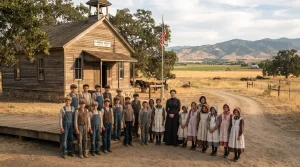 Education in the Early Days of Stanislaus County
Stanislaus County’s educational history developed as the region’s population grew.
During the nineteenth century, much of the Central Valley was rural. Agriculture was becoming increasingly important, communities were developing around transportation routes and waterways, and families needed schools close to where they lived.
Unlike today’s large campuses, early schools could be very small.
A rural schoolhouse might serve children from several nearby farms. Students of different ages could learn in the same room under one teacher. The school building itself could also serve purposes beyond education.
This was particularly important in isolated agricultural communities.
Travel was more difficult than it is today, and residents did not have easy access to large public buildings. A school could therefore become a meeting place where neighbors gathered for community events, discussions, celebrations, and other activities.
The history of Roberts Ferry illustrates this pattern. The Roberts Ferry Historical Society records that the first school in the area was established in 1855. Several small schools eventually served the community before they were consolidated into a new Roberts Ferry schoolhouse in 1923.
The story demonstrates how educational systems changed as communities developed.
Small schools could be appropriate when families lived relatively far apart. As populations increased and transportation improved, districts could consolidate schools and create larger educational facilities.
The County Superintendent and the Growth of Education
The development of organized education also required local administration.
The Stanislaus County Office of Education traces the county superintendent position back to the 1850s. Its historical information identifies 1854 as the beginning of the county’s superintendent record and notes that the position initially involved the county assessor before California legislation changed the structure of the office.
This period is significant because Stanislaus County itself was still young.
Education was becoming part of the local governmental structure at approximately the same time that communities were establishing their identities.
Over the following decades, schools became increasingly organized. District boundaries were created, teachers were hired, buildings were constructed, and communities began developing educational traditions that could last for generations.
Many of today’s school districts have roots in this period of expansion.
One-Room Schoolhouses Across the Central Valley
One-room schoolhouses are among the most recognizable symbols of nineteenth-century American education.
In Stanislaus County, these schools were particularly important because of the region’s rural character.
A family living on a farm could not necessarily send children several miles to a large school. A small schoolhouse located within the surrounding community provided a practical solution.
The building itself might be simple, with wooden walls, large windows, a stove for heating, desks, a chalkboard, and a small collection of books.
The teacher had an enormous responsibility.
One instructor could be responsible for children at different grade levels and with different educational needs. Lessons had to be organized carefully so students could work independently while the teacher worked with another group.
These schools also created social connections.
Children from neighboring farms met at school even when their families lived far apart. Parents interacted with teachers and other families. Community events could bring residents together.
In this way, the schoolhouse became part of the social structure of rural Stanislaus County.
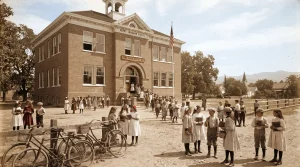 Ceres: One of Stanislaus County’s Important School Stories
The development of education in Ceres provides an especially interesting example of how school history reflects community growth.
The Ceres Courier reports that the Davis School District was organized on January 27, 1859, by Harvey Bates Davis. The original school was located near what later became the Hatch Road and Highway 99 area.
At the time, Ceres was a developing agricultural settlement rather than the modern city residents know today.
The original school was a one-room institution, but the community grew quickly enough that the facility needed to expand.
In 1870, the school was enlarged. Several years later, in 1874, the building was moved into Ceres and placed in the area that became Triangle Park, now known as Whitmore Park.
The move is an excellent example of how schools followed community development.
When a settlement changed, its school could change with it.
A School Was More Than a Classroom
One of the most interesting aspects of early Ceres school history is the role the school played outside the classroom.
According to the Ceres Courier’s historical account, the early school building served as the community’s only public building for a period.
That meant the school was also a place for meetings and community activities.
Today, Americans are accustomed to having separate buildings for schools, city government, libraries, community centers, and other services. In a small nineteenth-century settlement, however, resources were limited.
One building could serve many purposes.
This makes historic schools important when studying the development of local communities. They reveal not only how children were educated but also how residents organized their social and civic lives.
From Davis School District to Ceres School District
School names can also reveal changing community identities.
The district originally known as the Davis School District was officially renamed the Ceres School District in 1897.
The change reflected the increasing importance of Ceres as an established community.
This is an important characteristic of local history: names can change as communities change.
A school may begin with the name of a person associated with a settlement. Later, as the settlement develops into a recognized town or city, the geographic name may become more appropriate.
The transition from Davis School District to Ceres School District therefore represents more than an administrative change. It reflects the growth of local identity.
The White Brick School
Another memorable chapter in Ceres educational history involves the White Brick School.
In 1909, land was acquired on North Street for a new school. The building was constructed using white brick made from a sandy material that gave it an unusual appearance.
The new facility represented the community’s investment in education.
Instead of relying on a small rural schoolhouse, Ceres was developing larger educational facilities that reflected a growing population.
When the school opened, students and teachers moved supplies and equipment from the older facilities into the new building. The opening became a community event attended by hundreds of people.
This detail provides an important glimpse into how residents viewed education.
A school opening was not simply a construction project. It could become a major event involving families throughout the community.
The school later became known as Ceres Grammar School.
Its history eventually came to an end when the property was transferred for other public uses. The historic structure itself was destroyed by fire in 1991 while the property was being used by the school district.
However, part of the building’s physical history survived.
Some of the original bricks were salvaged and incorporated into a later district-office site.
This is an excellent example of how preservation can work even when an original historic building cannot be saved.
The People Behind Ceres School Names
Some Stanislaus County schools are named after people whose contributions deserve closer attention.
Ceres school history includes names associated with farmers, educators, school administrators, attendance officials, and community members.
Caswell Elementary, for example, is associated with the Thomas Caswell family, who owned land in the area.
Carroll Fowler Elementary is associated with Carroll Fowler and agricultural property that became part of the school site.
Other school names recognize people who worked directly in education.
Mae Hensley Junior High was named after Mae Hensley, who served the community in an attendance-related role.
Sam Vaughn Elementary honors Sam Vaughn, whose career with the Ceres Unified School District extended over several decades.
These examples show how school naming practices can preserve a community’s institutional history.
A school name does not necessarily commemorate a nationally famous individual. In many cases, it recognizes someone whose greatest contributions were made at the local level.
That is one of the most valuable characteristics of local history.
Turlock High School Begins With 22 Students
Turlock provides another remarkable example of educational growth.
According to the official history of Turlock High School, the school opened in September 1906 with only 22 students.
The first classes were held in the town hall.
The original faculty consisted of S. R. Douglas and Maud Clark.
Imagine the difference between that small beginning and the educational institution that would eventually serve generations of Turlock families.
The early school quickly established traditions that helped define its identity.
Students selected blue and gold as school colors, and the first Alert yearbook was published.
The bulldog eventually became the school’s mascot.
These traditions are important historical records because they show that school identity was already developing during the earliest years of the institution.
From Town Hall to a Dedicated High School
Turlock High School did not remain in the town hall.
A dedicated high-school building opened in 1907 on the grounds of Turlock Covenant Church.
The new building represented the community’s investment in secondary education.
As Turlock grew, the need for larger educational facilities increased.
The original building remained part of the community’s educational story for decades before being demolished in 1963.
This pattern occurred throughout growing California communities.
Buildings that seemed modern when constructed eventually became outdated. Schools were replaced, campuses expanded, and new facilities were built.
Yet the historical importance of the original structures remained.
Agriculture and the Development of Schools
It is impossible to understand Stanislaus County school history without understanding agriculture.
Farming helped shape the region’s population, economy, transportation routes, and communities.
As agricultural production expanded, families settled throughout the Central Valley. Farms needed workers, communities needed services, and children needed schools.
The relationship was especially important in rural areas.
A school could be located near agricultural land because the families it served lived nearby.
Over time, roads improved and towns expanded. Some rural areas became incorporated communities, while others became part of larger cities.
Schools often remained as visible reminders of earlier settlement patterns.
The names of local schools can therefore help historians identify which families and communities were important during different stages of agricultural development.
School Names as Local History Archives
A school name can contain several layers of history.
Consider a school named after a person.
That name may lead researchers to investigate the person’s occupation, family, property, public service, or connection to education.
A school named after a geographic feature can lead researchers toward maps and settlement records.
A school named after a historic community may reveal how that settlement developed or changed over time.
Even changes in school names can be significant.
A district might change its name because a community grows, two districts consolidate, boundaries change, or residents adopt a new local identity.
For this reason, school directories and district records are valuable historical documents.
Schools and Immigration in the Central Valley
Stanislaus County’s population has been shaped by many waves of migration and immigration.
Agriculture attracted workers and families from different parts of the United States and the world.
Schools became places where children from different backgrounds interacted and received their education.
Over generations, students from immigrant families became teachers, business owners, farmers, public officials, and community leaders.
This broader history can sometimes be found in school yearbooks and local newspapers.
Photographs of student groups can show changing demographics. Names in graduating classes can reveal the many cultural and family backgrounds represented in a community.
For researchers, these records provide a valuable perspective on how Stanislaus County developed as part of California’s diverse Central Valley.
School Yearbooks as Historical Documents
Old school yearbooks are among the most useful resources for researching Stanislaus County history.
A yearbook can provide information that is difficult to find elsewhere.
It may include student names, photographs, teachers, school buildings, sports teams, clubs, performances, class officers, and advertisements from local businesses.
Advertisements are particularly valuable because they can document businesses that existed during a specific period.
A single yearbook can therefore provide information about both school life and the wider community.
For families researching their ancestors, yearbooks can also provide photographs and biographical clues.
A student who appears in a 1930s or 1940s school photograph may later appear in city directories, newspaper articles, military records, or local business records.
Schools therefore become an unexpected gateway into genealogy.
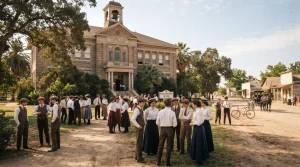 Historic Schools and the Changing Central Valley
The physical appearance of Stanislaus County has changed dramatically over the last century.
Agricultural communities expanded.
Roads became highways.
Automobiles replaced many forms of earlier transportation.
Small settlements grew into cities.
New residential neighborhoods appeared.
School campuses expanded to serve larger populations.
Yet older school names often remained.
This creates an interesting connection between past and present.
A student can attend a modern school with technology-filled classrooms while carrying a name that dates back generations.
The contrast demonstrates how local history remains embedded in modern communities.
Preserving School Buildings and Memories
Preserving school history does not always mean preserving the original building.
In some cases, a historic structure may be too damaged, unsafe, or expensive to maintain.
Preservation can instead involve documenting the building through photographs, architectural records, oral histories, newspapers, maps, and physical artifacts.
The story of the Ceres White Brick School demonstrates this concept.
Although the historic building no longer survives, records and salvaged materials continue to tell part of its story.
Museums can also recreate historic educational environments.
The McHenry Museum & Historical Society includes a one-room schoolhouse setting among its exhibits, allowing visitors to gain a better understanding of how early education looked and functioned in the region.
These efforts matter because physical spaces can disappear surprisingly quickly.
Using Primary Sources to Research a School
Reliable historical research should use more than a single website.
Official school and district histories can provide important dates and institutional information.
Local newspapers can reveal community reactions and events.
Historical societies can provide photographs and artifacts.
Museums may preserve documents that are not available online.
Maps can show changes in school locations.
Yearbooks can identify students and teachers.
Oral histories can preserve memories that never appeared in newspapers.
Family collections can sometimes contain photographs, letters, report cards, or graduation programs.
Combining these sources can produce a much richer history than relying on a single account.
It also allows researchers to identify differences between sources and investigate why those differences exist.
Stanislaus County Schools as Community Landmarks
Even modern schools can become historic landmarks over time.
A building that opened several decades ago may already represent multiple generations of students.
Parents may have attended the same school where their children later enrolled.
Teachers may have spent their entire careers in the same district.
Graduates may return to the community and recognize familiar names even after buildings have been renovated or replaced.
This continuity is one of the strongest reasons school history matters.
Schools connect generations.
A family may have photographs of three generations standing outside the same campus.
A former student may return years later and remember a teacher whose name remains attached to a classroom, athletic field, or school building.
These personal connections transform school history from a collection of dates into a living part of community memory.
Connecting Today’s Students With Yesterday’s Stanislaus County
Modern students may have difficulty imagining what school was like more than a century ago.
There were no smartphones, online classrooms, modern school buses, or digital textbooks.
In some rural areas, students traveled along dirt roads to reach small schoolhouses.
The teacher might have been responsible for students across several grade levels.
Heating could depend on a wood or coal stove.
Books and supplies were limited.
Yet the fundamental purpose of the school was familiar: children were gathering to learn and prepare for the future.
That connection makes school history particularly meaningful.
Technology and buildings change, but the importance of education remains.
Preserving the Stories Behind the Names
Stanislaus County’s historic school names deserve attention because they preserve pieces of community history that might otherwise fade.
A name on a school sign can represent an educator, farmer, administrator, family, neighborhood, or early settlement.
Learning the story behind that name gives residents a better understanding of the community around them.
The history of Ceres demonstrates how schools developed from small rural institutions into organized modern districts.
The history of Turlock High School demonstrates how an institution that began with only 22 students could become an enduring part of the community.
The story of Roberts Ferry demonstrates how rural schools adapted as communities changed.
Together, these examples reveal how closely education was connected to the growth of Stanislaus County.
How Residents Can Help Preserve Local School History
Residents do not have to be professional historians to contribute to local preservation.
Old school photographs can be valuable.
Yearbooks should be handled carefully and preserved whenever possible.
Family stories about former schools and teachers can be recorded.
Former students can write down their memories before details are forgotten.
Historic documents can be donated or shared with appropriate museums, archives, or historical organizations.
Even seemingly ordinary objects can have historical value.
A graduation program, school newspaper, classroom photograph, teacher’s certificate, or old report card can help future researchers understand how education changed over time.
Digital preservation is also increasingly important.
Photographs and documents can be scanned and backed up so that information survives even if the original item deteriorates.
The Continuing Story of Stanislaus County Schools
The history of Stanislaus County schools is not finished.
New schools continue to open.
Older campuses are renovated.
District boundaries change.
Communities expand.
Students create new traditions.
At the same time, older school stories continue to provide context for the present.
The modern educational landscape of Stanislaus County was built over generations.
Each schoolhouse, teacher, student, family, and community contributed another chapter.
The names found on today’s schools provide a direct connection to those earlier chapters.