
How Agriculture Shaped Stanislaus County and the California Central Valley
Agriculture has done more than provide food for Stanislaus County. It has helped shape the county’s communities, economy, landscape, transportation network, family traditions, and connection to the broader California Central Valley. From orchards and vineyards to dairy farms, field crops, livestock operations, and food-processing businesses, farming has influenced everyday life across the region for generations.
Located in the heart of California’s Central Valley, Stanislaus County occupies an important position between the agricultural communities of the San Joaquin Valley. Modesto, Turlock, Ceres, Patterson, Riverbank, Oakdale, and Newman have all developed alongside an agricultural economy that continues to connect rural land with growing urban communities.
The importance of that relationship remains visible today. Stanislaus County reported approximately 876,464 harvested acres and $3.4 billion in agricultural commodity value in 2023. The county’s agricultural economy includes fruit and nut crops, vegetables, field crops, seed crops, nursery products, livestock, poultry, dairy-related production, and other agricultural categories.
Understanding how agriculture shaped Stanislaus County therefore means looking beyond individual farms. It means examining how land, water, transportation, technology, labor, markets, and communities developed together and transformed a large portion of California’s Central Valley.
The Central Valley: A Natural Foundation for Agriculture
The geography of California’s Central Valley created an important foundation for agricultural development. The valley is a broad interior region extending through much of California and includes the Sacramento Valley in the north and the San Joaquin Valley in the south.
The region’s relatively flat terrain, fertile soils, Mediterranean climate, and access to rivers created conditions that could support extensive agricultural production. Historically, however, the valley’s environment looked very different from the cultivated landscape seen today.
The U.S. Forest Service notes that around the time of the Gold Rush in 1849, extensive riparian vegetation and wetlands covered large portions of the Central Valley floor. Over time, water management, land conversion, agricultural development, and infrastructure dramatically changed that landscape.
Agriculture did not develop simply because the land was naturally productive. Farmers and communities needed systems for managing water, preparing fields, moving crops, raising livestock, and reaching markets. The transformation of the Central Valley was therefore also a story of infrastructure and human adaptation.
As irrigation expanded, land that depended heavily on seasonal rainfall could increasingly support more consistent agricultural production. Canals, reservoirs, wells, roads, railroads, and later highways became essential components of the agricultural economy.
Stanislaus County became part of this larger transformation.
Agriculture and the Early Development of Stanislaus County
Before modern agriculture dominated the landscape, the Central Valley supported Indigenous communities that had developed sophisticated relationships with the region’s rivers, wetlands, grasslands, plants, and wildlife.
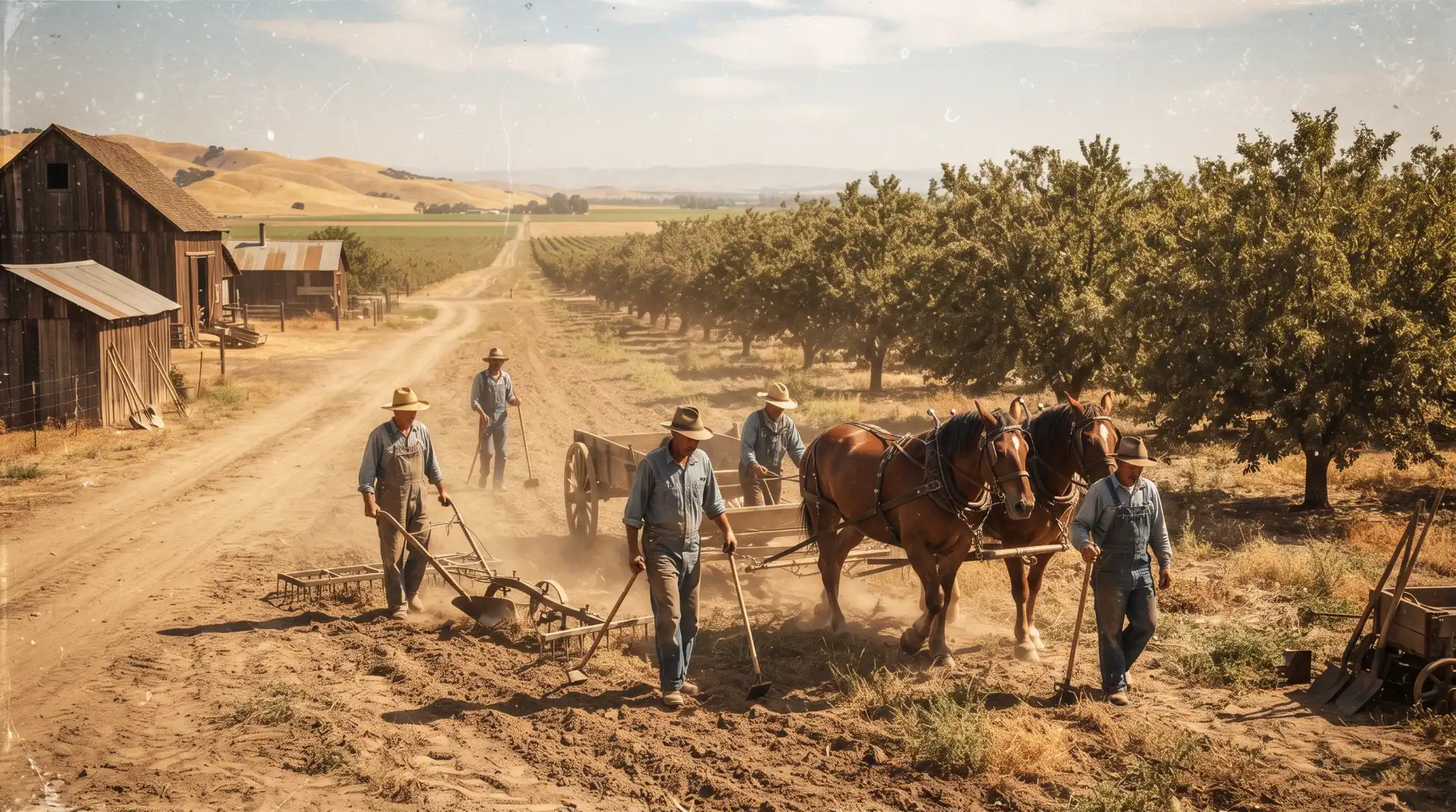
The arrival of American settlers and the rapid population growth associated with the Gold Rush changed the economic direction of the Central Valley. Agriculture became increasingly important as communities needed reliable supplies of food and other agricultural products.
Stanislaus County was established in 1854. Its location along the Tuolumne, Stanislaus, and San Joaquin river systems provided important geographic connections for agricultural development.
Early farming operations included grains, livestock, and other crops suited to the regional environment. As transportation improved and irrigation became more extensive, farmers gained opportunities to produce a wider variety of agricultural commodities.
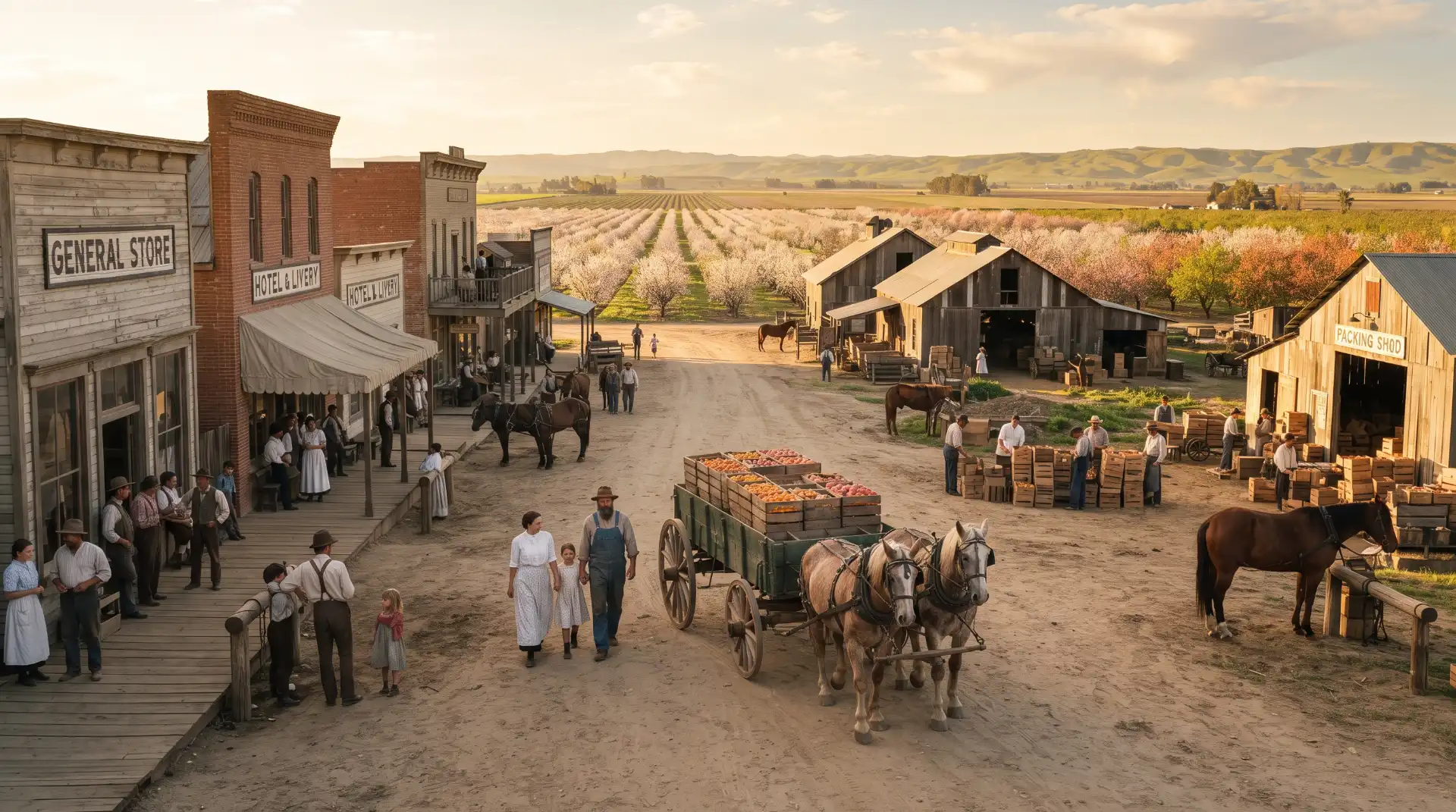
Small agricultural communities gradually developed around farms, ranches, waterways, roads, and commercial centers. Towns grew because farmers needed places to purchase supplies, sell products, obtain services, transport goods, and interact with one another.
In this way, agriculture helped establish the economic foundations of many communities that remain important to Stanislaus County today.
Irrigation Changed What Farmers Could Grow
Water is one of the most important parts of the agricultural story in the Central Valley.
The region receives most of its precipitation during the cooler months, while many crops require substantial water during the warmer growing season. This creates a fundamental challenge for agriculture: water must be managed and distributed when and where crops need it.
The development of irrigation infrastructure significantly expanded agricultural possibilities.
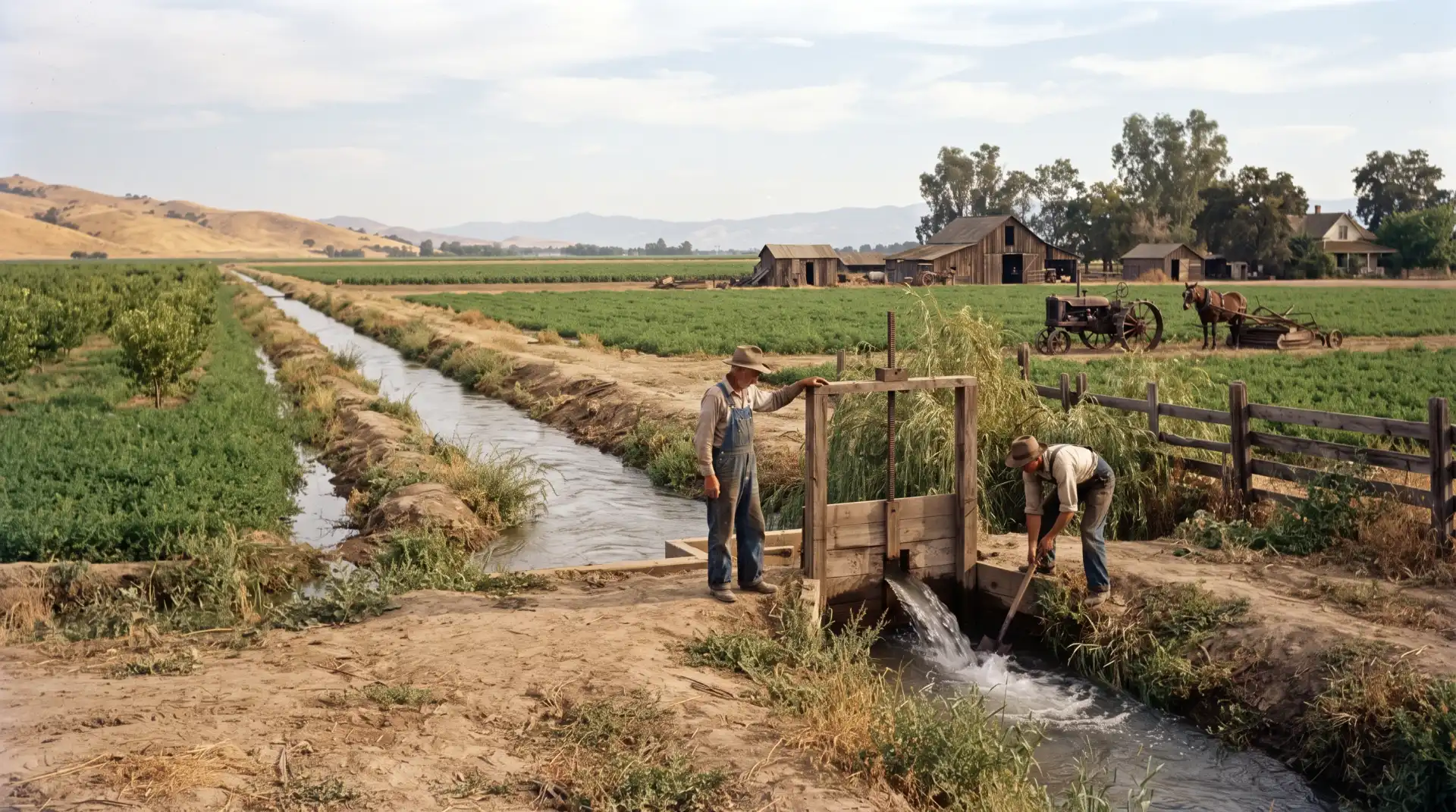
Instead of relying solely on rainfall, farmers could use water from rivers, reservoirs, canals, groundwater, and other systems. Irrigation allowed agricultural producers to cultivate crops during California’s dry summer months and contributed to the region’s ability to support high-value specialty crops.
The USDA explains that California’s combination of favorable climate and extensive water infrastructure has supported the cultivation of a wide variety of crops. The state is particularly known for specialty crops, including fruits, vegetables, nuts, and other agricultural products.
For Stanislaus County, irrigation became closely connected to the growth of orchards, vineyards, field crops, forage production, and livestock agriculture.
Water also became one of the most important long-term issues facing farmers and communities. Drought, groundwater conditions, environmental requirements, infrastructure needs, and changing agricultural practices continue to influence decisions about what can be grown and where.
Orchards and Specialty Crops Transform the Landscape
One of the most recognizable features of California’s agricultural landscape is the orchard.
Over generations, Central Valley farmers developed extensive production systems for tree nuts and fruit. Stanislaus County became particularly associated with crops such as almonds, walnuts, peaches, and other fruit and nut commodities.
Orchards require long-term investment. Unlike annual crops that can be planted and harvested within a single growing season, trees can remain productive for many years. Establishing an orchard therefore represents a long-term commitment involving irrigation systems, soil preparation, pruning, pest management, harvesting, and marketing.
The expansion of orchards also influenced the appearance of rural Stanislaus County. Rows of trees became defining elements of the countryside, especially around communities such as Modesto, Oakdale, Turlock, and Patterson.
Today, California remains a major national agricultural producer. USDA data show the continuing economic importance of commodities such as almonds and other specialty crops, alongside dairy, livestock, vegetables, grains, and numerous other agricultural products.
The diversity of these crops demonstrates that Central Valley agriculture is not based on one commodity. It is a complex agricultural system containing numerous interconnected industries.
Dairy Farming Became a Major Part of the County’s Identity
Agriculture in Stanislaus County is not limited to crops.
Dairy farming has played an important role in the county’s agricultural economy and rural landscape. Dairy operations require substantial quantities of feed, water, land, equipment, transportation, veterinary services, and processing infrastructure.
This created connections between crop farming and livestock production.
Crops such as alfalfa, corn, and other forage products can support livestock operations, while dairy production generates demand for transportation, agricultural services, equipment maintenance, feed suppliers, and processing facilities.
California remains one of the country’s leading dairy-producing states. USDA statistics for 2025 show California with approximately 1.71 million milk cows and more than 40 billion pounds of milk production.
For Stanislaus County, dairy farming has therefore represented more than an individual agricultural activity. It has formed part of a broader regional agricultural network.
The presence of dairies also influenced rural communities and land-use patterns. Roads, agricultural service businesses, feed operations, veterinary practices, equipment suppliers, and processing facilities all developed in connection with the needs of agricultural producers.
Agriculture Created an Agricultural Business Network
A common misconception is that agriculture’s economic impact can be measured only by the value of crops leaving a farm.
In reality, agricultural production supports a much broader network.
Farmers need tractors, irrigation equipment, fertilizer, seeds, animal feed, fuel, repair services, pest-control services, veterinary care, harvesting equipment, transportation, storage, insurance, financial services, packaging, processing, and distribution.
This means agricultural activity can affect businesses far beyond rural properties.
Stanislaus County’s economic development documents identify agriculture as a major component of the local economy and report billions of dollars in annual agricultural commodity value. The county has also identified employment connections between agriculture and related food manufacturing.
That relationship helps explain why agriculture has remained significant even as Stanislaus County has grown more urban.
A farm may be located outside a city, but the agricultural economy can influence businesses, workers, transportation systems, schools, restaurants, manufacturers, and other organizations throughout the region.
Railroads, Roads, and Highways Connected Farms to Markets
Agriculture depends on transportation.
Crops have to move from fields to packing facilities, processing plants, distribution centers, markets, and eventually consumers. Livestock and dairy products also require specialized transportation systems.
As transportation infrastructure improved, Stanislaus County became increasingly connected to larger California markets and national distribution networks.
Railroads played an important historical role in connecting agricultural communities to markets. Later, roads and highways expanded those connections.
Today, Interstate 5, State Route 99, and other major transportation corridors help connect the Central Valley with the San Francisco Bay Area, Sacramento, Southern California, and other markets.
This transportation network is one reason agriculture in the Central Valley can operate on a large commercial scale. Fresh produce and other agricultural commodities can move quickly from production areas to processing and distribution centers.
Transportation also helped shape the location and growth of communities. Businesses developed near important transportation corridors because agricultural producers needed convenient access to supplies and markets.
Food Processing Expanded Agriculture’s Economic Reach
Growing crops is only one part of the food system.
Agricultural products often need to be sorted, packed, processed, stored, transported, or manufactured before reaching consumers. As the agricultural economy expanded, food-processing industries became increasingly important throughout California’s Central Valley.
For Stanislaus County, this created additional employment and business opportunities.
A crop harvested in the county may eventually become part of a packaged food product, ingredient, beverage, animal feed product, or other consumer good. This creates a chain connecting farms with manufacturers, warehouses, transportation companies, retailers, and consumers.
Food processing also helps explain why agriculture continues to influence urban areas.
A person working in agriculture does not necessarily work on a farm. They may work in food manufacturing, equipment repair, transportation, agricultural technology, logistics, laboratory services, packaging, or another related field.
The agricultural economy therefore reaches far beyond the boundaries of individual farms.
Agriculture Helped Shape Stanislaus County Communities
Many Central Valley communities developed with agriculture at their center.
Modesto became a major commercial and population center while remaining closely connected to surrounding agricultural land. Turlock developed within a landscape strongly influenced by farming and irrigation. Ceres, Oakdale, Patterson, Newman, and other communities likewise retain visible connections to agriculture.
The relationship between agriculture and communities can be seen in local businesses, agricultural fairs, farmers markets, historic buildings, family farms, food traditions, and rural landscapes.
Agriculture also influenced the rhythm of community life.
Planting and harvesting seasons created periods of increased labor demand. Agricultural calendars affected transportation, employment, commerce, and family routines.
Over time, agricultural communities became more diverse. Families from different backgrounds contributed to farming, food processing, agricultural services, and other industries.
This history is an important part of understanding Stanislaus County today.
Family Farms and Generational Knowledge
Agriculture is also a story about people.
Farming requires knowledge that is often developed through years of experience. Understanding local soils, irrigation practices, weather patterns, pests, crop development, machinery, and harvesting conditions can take decades.
In many agricultural communities, knowledge has traditionally moved from one generation to another.
Children who grew up around farms often learned about agricultural work from parents, grandparents, relatives, and neighbors. Some continued farming, while others entered related industries.
Modern agriculture, however, increasingly combines traditional knowledge with technology.
Farmers now use satellite imagery, sensors, GPS-guided equipment, weather information, improved irrigation systems, data analysis, and other technologies to make decisions about crops and resources.
This represents an important evolution rather than a complete break from the past.
The fundamental goal remains similar: produce agricultural products efficiently while responding to changing environmental and economic conditions.
Agriculture and Changing Technology
Technology has transformed nearly every stage of farming.
Modern equipment can plant, cultivate, harvest, and transport crops with greater precision than earlier generations could achieve. Irrigation technology can help producers apply water more efficiently. Agricultural monitoring systems can provide information about soil moisture, crop conditions, weather, and pests.
Technology also affects livestock operations.
Modern dairy farms use specialized systems to monitor animal health, manage feed, collect production information, and maintain facility conditions.
These technologies allow agricultural producers to respond to rising costs, labor challenges, resource limitations, and market expectations.
The Central Valley’s agricultural economy has therefore evolved from primarily manual and animal-powered systems into a highly mechanized and increasingly data-driven industry.
Water, Drought, and the Future of Farming
The same water systems that helped agriculture expand also create some of the region’s most important challenges.
California’s agricultural economy depends heavily on reliable water supplies. Drought can reduce water availability, increase production costs, alter planting decisions, and affect agricultural communities.
USDA research on California’s changing agroclimate shows that farmers must account for factors such as growing-season length, heat exposure, frost, and crop water requirements.
Climate conditions can therefore influence not only what farmers grow but also when they plant, how they irrigate, and how they manage long-term investments.
Stanislaus County has experienced changes in agricultural acreage and commodity value over time. County data show that harvested acreage declined from 961,838 acres in 2019 to 876,464 acres in 2023, while total agricultural commodity value changed from approximately $3.6 billion to $3.4 billion over the same period. The county notes that weather, soil, markets, regulatory changes, agricultural policies, and drought-related water conditions can affect these figures.
These numbers illustrate that agriculture is dynamic. The agricultural landscape visible today is not necessarily the same landscape that future generations will inherit.
Urban Growth and Agricultural Land
Stanislaus County has also experienced population and urban development pressures.
As communities grow, agricultural land can come under pressure from residential development, commercial construction, transportation projects, and other forms of land conversion.
This creates difficult questions about how communities can accommodate population growth while maintaining agricultural land and the economic systems connected to it.
The issue is not simply about preserving open space. Agricultural land can support food production, local businesses, wildlife habitat, scenic landscapes, and rural community identities.
At the same time, communities need housing, infrastructure, schools, businesses, and transportation.
The future of Stanislaus County will therefore involve decisions about how agricultural and urban landscapes coexist.
Why Agriculture Still Matters to Stanislaus County
Despite major changes in technology, demographics, transportation, and economic development, agriculture remains one of Stanislaus County’s defining industries.
The county’s own performance reporting describes agriculture as a vital part of the local economy. In 2023, the county recorded more than $3.4 billion in agricultural commodity value across hundreds of thousands of harvested acres.
The county’s Agricultural Commissioner also describes the agricultural industry as a critical part of the region, with responsibilities ranging from pest detection and inspections to permitting, export services, and marketplace oversight.
This institutional infrastructure demonstrates how deeply agriculture is integrated into local government and economic systems.
Agriculture is not simply something happening outside the cities. It is part of the larger economic and cultural structure of the county.
Stanislaus County as Part of the California Agricultural Story
The story of Stanislaus County cannot be separated from the broader history of California agriculture.
California’s Central Valley has become one of the world’s most productive agricultural regions, supported by a combination of fertile land, favorable growing conditions, irrigation infrastructure, transportation, technology, skilled agricultural workers, and access to domestic and international markets.
The USDA describes California as an exceptionally diverse agricultural state, producing hundreds of commercial crops and supporting major industries in fruits, vegetables, nuts, dairy, livestock, nursery products, and other commodities.
Stanislaus County represents one part of that much larger system.
Its farms and ranches are connected to markets throughout the United States and around the world. At the same time, agriculture remains deeply local. It shapes roads, communities, businesses, family histories, landscapes, and traditions that residents encounter every day.
Preserving the Agricultural History of Stanislaus County
Understanding agricultural history is also a way of understanding local history.
Old farm properties, historic irrigation systems, agricultural buildings, equipment, photographs, newspapers, family stories, and community records can reveal how people lived and worked in previous generations.
Preserving these stories matters because agriculture has influenced much more than the production of food. It has helped determine where communities developed, how people earned a living, how transportation systems expanded, and how the Central Valley became connected to national and global markets.
For a county such as Stanislaus, agricultural history is therefore community history.
It is the story of farmers and ranchers, farmworkers, engineers, business owners, mechanics, teachers, families, merchants, processors, transportation workers, and countless others whose lives became connected through agriculture.
Looking Toward the Future
Agriculture in Stanislaus County will continue to change.
Future farming will likely involve greater use of technology, more precise water management, changing crop choices, evolving labor practices, new environmental requirements, and continued pressure from urban growth.
Farmers will also have to respond to changing markets and climate conditions.
Yet the basic importance of agriculture to the region remains clear.
The county’s modern agricultural industry is the result of generations of development. Irrigation transformed the possibilities of the land. Transportation connected farms with markets. Orchards and vineyards reshaped the countryside. Dairy operations strengthened the livestock economy. Food processing expanded agriculture’s reach. Technology transformed how farms operate.
Each stage added another layer to the history of Stanislaus County.
Conclusion
Agriculture shaped Stanislaus County by influencing its economy, communities, transportation systems, landscape, businesses, and cultural identity.
What began as a developing agricultural region became part of one of the most productive farming areas in the United States. The Central Valley’s transformation required more than fertile soil. It depended on irrigation, infrastructure, transportation, technology, labor, markets, and generations of agricultural knowledge.
Today, Stanislaus County continues to demonstrate the lasting importance of that history. With hundreds of thousands of harvested acres and billions of dollars in annual agricultural commodity value, farming remains a major part of the county’s economic identity.
At the same time, agriculture is not frozen in the past. It continues to evolve as farmers respond to water availability, climate conditions, technology, markets, regulations, and changing communities.
For anyone exploring Stanislaus County’s history, agriculture provides one of the clearest ways to understand how the region became what it is today.
The orchards, farms, dairies, fields, roads, businesses, and communities across the county are all part of a much larger story: the transformation of California’s Central Valley and the generations of people who helped make agriculture a defining part of its identity.
Recommended Authoritative External Resources
For readers interested in agricultural statistics and California farming, the USDA National Agricultural Statistics Service (NASS) provides California agricultural data, crop information, county estimates, and statistical resources. USDA National Agricultural Statistics Service – California
The USDA California Climate Hub also provides research and information about climate conditions affecting California agriculture, including water requirements, heat, frost, and growing-season changes. USDA California Climate Hub – Agroclimate Metrics